
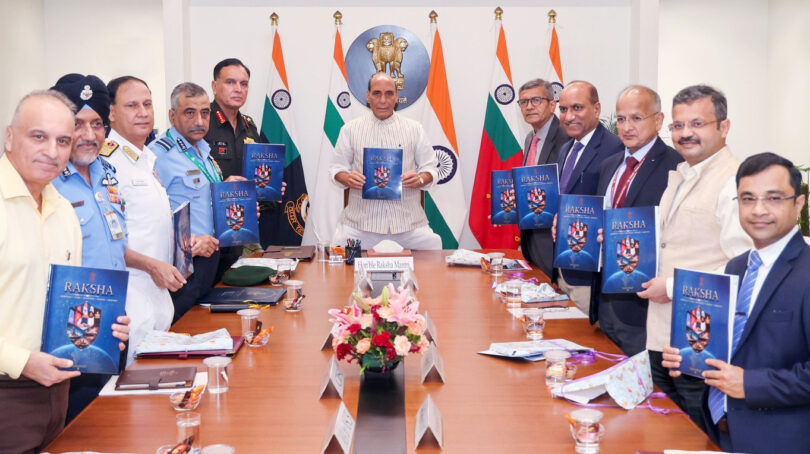

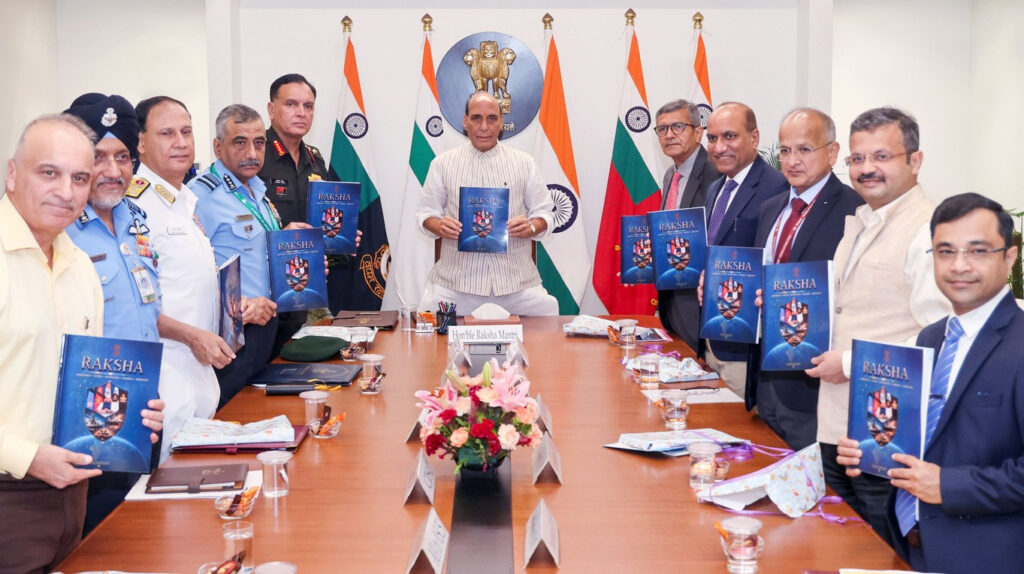
On 3 September 2026, the Indian Defence Minister Rajnath Singh released a document titled RAKSHA at Kartavya Bhawan in New Delhi. The Ministry of Defence (MoD) describes this document as India's strategic roadmap and vision for global defence partnerships for the next ten years.
Chief of the Army Staff General Dhiraj Seth, Defence Secretary Rajesh Kumar Singh, Secretary (Defence Production) Sanjeev Kumar, Secretary (East) in the Ministry of External Affairs Rudrendra Tandon, Vice Chief of the Air Staff Air Marshal Ashutosh Dixit, Vice Chief of the Naval Staff Vice Admiral Ajay Kochhar, and the Chief of Integrated Defence Staff to the Chairman Chiefs of Staff Committee and Air Marshal Tejinder Singh were present at the launch. The guest list included members of all three services, the defence production establishment and India's foreign ministry.
The Ministry explicitly stated that the document “marks a shift in India's strategic engagement, aligning national security objectives with proactive global cooperation, fostering long-term stability and mutual growth.”
Taking to X, the Directorate of Public Relations, Ministry of Defence, highlighted the document, stating that it was “setting a 10-year roadmap to strengthen global security partnerships,” built to position India as “an anchor of regional stability.”
(At the time of this analysis presented, coverage of RAKSHA is almost entirely downstream of Ministry of Defence and Press Information Bureau releases such as those drawn from PIB, Akashvani/News on Air, ANI, DD India)
The Four Pillars
The document highlights four stated pillars, consistent across every official release reviewed:
- Strategic Partnerships: bolstering strategic security framework with partner nations.
- Capacity Building: Scaling joint military exercises, expanding cooperative training frameworks, and institutionalizing the exchange of tactical and operational best practices with allied and partner nations.
- Indigenous Exports: advancing Make-in-India defence platforms for India to be acknowledged as a reliable global defence manufacturing hub.
- Maritime Security: Reinforcing India's role as a Net Security Provider and First Responder in the Indian Ocean Region.
The Ministry emphasized “defence diplomacy is a core pillar of India's foreign policy,” and that RAKSHA “provides a clear, actionable vision for the next decade, ensuring that India remains an anchor of peace, stability, and rule-based order in an evolving global landscape.”
The passage is broadly well-argued, but it can be strengthened by tightening the language, reducing repetition, distinguishing clearly between verified facts and analytical interpretation, and adopting a more formal strategic-affairs style. A few claims—particularly those attributing causality to export growth or assessing RAKSHA’s significance—should remain framed as interpretations rather than established conclusions unless supported by primary evidence.
Raksha Mantri Shri @rajnathsingh released the landmark ‘RAKSHA’ document on defence diplomacy in New Delhi on September 03, 2026, setting a 10-year roadmap to strengthen global security partnerships. Aligning national security with proactive international cooperation, this… pic.twitter.com/gkT3QVzeGF
— Ministry of Defence, Government of India (@SpokespersonMoD) September 3, 2026
What RAKSHA Changes
It can most certainly be determined, the central take away of RAKSHA is not simply reflective of its four pillars or the efforts India has pursued for year, but in the manner those activities are now being organised, integrated, and publicly articulated. The document India’s intent by formally codifying its objectives in strategic layout.
Furthermore, exercises, defence agreements, capacity-building programmes, and naval deployments are now presented as elements of a declared long-term strategy rather than individual initiatives.
On basis of the indicated text in the document, it can be inferred that RAKSHA serves to integrate disparate lines of defence engagement into a unified, coherent policy architecture.
Analytically, the document’s primary value is institutional rather than doctrinal. The collective endorsement of this framework by the armed services, the defence production sector, and the Ministry of External Affairs (MEA) indicates a crucial milestone which outweighs any individual initiative within the text. It is evident that RAKSHA functions less as a new policy declaration and more as a joint mechanism to synchronize existing instruments of national power under a common strategic vision of the nation.
India has unveiled ‘RAKSHA’ defence diplomacy document, outlining its strategic roadmap & vision for global partnerships over next 10 years.
— Ministry of Information and Broadcasting (@MIB_India) September 9, 2026
The document marks a shift in India’s strategic engagement, aligning national security objectives with proactive global cooperation,… pic.twitter.com/meL6vJzWfq
The Maritime Pillar: Continuity Rather Than Innovation
The fourth pillar of RAKSHA—Net Security Provider and First Responder, builds directly upon a well-established policy foundation spanning more than ten years.
Prime Minister Narendra Modi first articulated the SAGAR (Security and Growth for All in the Region) doctrine during a visit to Mauritius in March 2015. A decade later, SAGAR evolved into MAHASAGAR (Mutual and Holistic Advancement for Security and Growth Across Regions), expanding India’s maritime outlook from the Indian Ocean littoral to a wider Global South framework.
Correspondingly, the operational foundations of India’s “First Responder” identity were also cemented long before the launch of RAKSHA. These include humanitarian assistance and disaster relief operations following the 2004 Indian Ocean tsunami, assistance to Myanmar after Cyclone Nargis in 2008, emergency support to the Maldives during its 2014 water crisis, and Operation Brahma after the 2025 Myanmar earthquake. Additionally, sixteen maritime nations participated in the Indian Ocean Ship SAGAR initiative in 2026, a deployment described by the Chief of the Naval Staff as both rare and significant.
Collectively, these precedents indicate that RAKSHA does not codify a novel maritime doctrine but it clearly institutionalizes and publicly bolsters a strategic role that India has effectively executed.
The Export Pillar: The Most Measurable Dimension
Among RAKSHA's four pillars, indigenous defence production and exports provide the clearest evidence of tangible progress. In comparison to the other pillars, which largely stress on policy intent and strategic direction, the export pillar can be assessed through measurable outcomes and publicly available data.
India's defence exports hit a record ₹38,424 crore in FY 2025–26, displaying a 62.66 percent increase over the previous year's figure of ₹23,622 crore. This indicates there is a continued development of India's defence manufacturing ecosystem and its increasing acceptance in international markets.
Both public and private sector entities contributed significantly to this performance. Defence Public Sector Undertakings (DPSUs) accounted for 54.84 percent of total exports, while private-sector firms contributed the remaining 45.16 percent. Furthermore, DPSU exports reportedly shot up by more than 150 percent with comparison to the previous year.
Defence exports have risen from just ₹686 crore in FY 2013–14 to ₹38,424 crore in FY 2025–26, highlighting a massive evolution in India's capability to market and deliver indigenous military equipment abroad. During the same period, indigenous defence production expanded from ₹46,429 crore in FY 2014–15 to approximately ₹1.78 lakh crore, while the defence budget increased from ₹2.53 lakh crore to ₹7.85 lakh crore in FY 2026–27.
India's defence products are now exported to more than eighty nations. The number of registered defence exporters also increased from 128 to 145 within a year, indicating broader participation by Indian industry in the global defence marketplace.
These developments have caused India to surpass the government's earlier target of ₹35,000 crore in annual defence exports by FY 2025–26. Consequently, New Delhi has raised its chips further, setting a goal of ₹3 lakh crore in defence production and ₹50,000 crore in defence exports by 2029.
The other factor for the acceleration can be attributed to administrative reforms, including streamlined export licensing procedures and improvements to export authorisation mechanisms. While this interpretation is plausible, available evidence does not yet conclusively establish a direct causal relationship.
Belgium Agreement as a Practical Test Case
RAKSHA’s launch has coincided with a defence-industrial engagement between India and Belgium.
During a visit to New Delhi, Belgian Minister of Defence and Foreign Trade Theo Francken met Defence Minister Rajnath Singh while Belgian Prime Minister Bart De Wever also visited India. The meetings have led to multiple agreements and memoranda under the framework of defence industrial cooperation.
According to reported remarks, Francken argued that trust between the two countries had already been established and that the next phase should focus on tangible cooperation through joint projects, training programmes, and industrial partnerships.
The Belgian Security and Defence Industry Association and the Society of Indian Defence Manufacturers signed a cooperation agreement designed to facilitate company-to-company collaboration and aid co-development initiatives under the Make in India framework. This aligns closely with RAKSHA’s emphasis on defence industrial partnerships and export-oriented manufacturing.
Rajnath Singh reportedly characterised the broader international environment as one of considerable geopolitical and economic uncertainty. However, as these remarks are available primarily through secondary reporting rather than an official transcript and further assessment may be ascertained once official transcripts are available.
Conclusion
What RAKSHA Actually Accomplishes
- It Formalises Existing Practice
Virtually every substantive component of RAKSHA predates the document itself. SAGAR and MAHASAGAR, defence export promotion, military training partnerships, and the expansion of defence diplomacy networks were already underway.
- It Signals a Greater Willingness to Be Planned Around
Historically, India’s defence diplomacy has emphasised flexibility over formal declarations. While this approach maximised strategic autonomy, it sometimes made long-term planning more difficult for partners and industry.
RAKSHA may be an answer providing a conscious decision to trade a degree of flexibility for greater predictability. If successful, that shift may prove more beneficial than any individual programme described within the framework.
- Independent Scrutiny Remains Limited
A major limitation in assessing RAKSHA is the lack of substantial independent evaluation. At the time of writing, there is little evidence of detailed parliamentary scrutiny, or sustained strategic debate concerning the framework.
The credibility of RAKSHA will become clearer over the next two years through several measurable indicators depending on whether the 2029 production and export targets are accompanied by transparent interim milestones or whether new defence attaché deployments generate tangible defence-industrial results rather than merely expanding diplomatic presence. Additionally the outcome of the India–Belgium industry partnership will be important to monitor as well.
More on related topics:
PRAHAAR — India’s First National Counter-Terrorism Policy: https://www.thestrategicperspective.org/prahaar-indias-first-national-counter-terrorism-policy/
India’s three new Joint Doctrines for Armed Forces: https://www.thestrategicperspective.org/indias-three-new-joint-doctrines-for-armed-forces/
Book review: The India Century: Vision 2047: Economy, Security, Geopolitics & Beyond: https://www.thestrategicperspective.org/the-india-century-vision-2047-economy-security-geopolitics-and-beyond/