

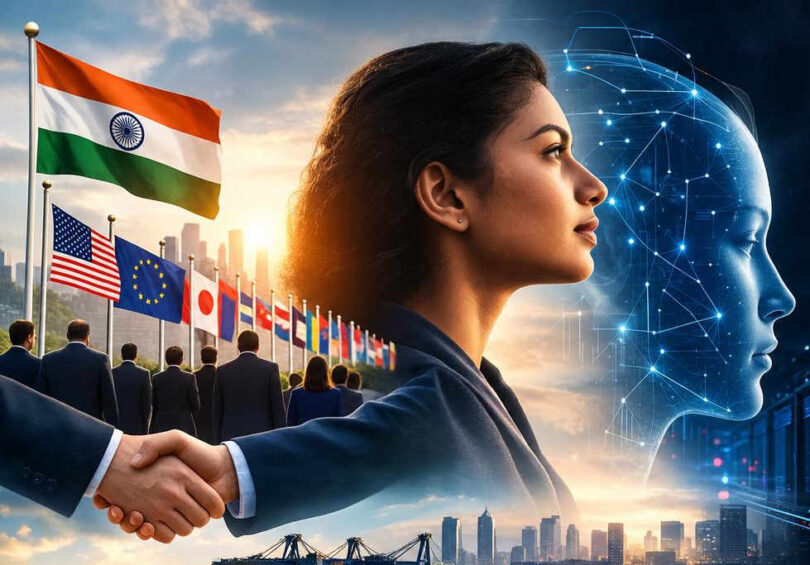
Artificial Intelligence (AI) is storming the world but concerns are rising high. Ai-enabled political propaganda in India (memes included) is a constant source of humour. There is considerable hype about India becoming a leading AI super-power with foreign entities aggressively seeking to collaborate with India in AI.
Global tech giants are injecting hundreds of billions into building India's foundational compute, cloud, and energy infrastructure to support advanced AI: Amazon committing additional USD 13 billion; Microsoft pledging USD 17.5 billion; Meta partnering Reliance Industries and investing USD 900 million for fintech innovations; Sweden-India Technology and AI Corridor (SITAC); EU-India partnership in AI; India, the US, UK, and EU Global Partnership on AI (GPAI); global AI hardware leaders helping to provide tech backbone to India.
But while international alliances accelerate tech growth, heavy reliance on foreign entities for AI poses structural, economic, and geopolitical risks for a developing digital economy like India:
- Foreign reliance for core infrastructure implies access to critical cloud computing, advanced graphical processing units (GPUs) - proprietary models could be restricted/cut off for national AI ecosystems if geopolitics shift.
- Foreign funding/building national digital infrastructure gives them significant leverage over public service delivery systems, compromising ability to operate independently.
- Collaborating with international hyper-scalers implies routing localized data through foreign-owned cloud servers – exposing sensitive demographic, financial, and healthcare data.
- Foreign entities can exploit diverse, localized data to train their proprietary models, commercialize outputs globally and sell the refined technology back to India.
- Capital-rich multinationals can outspend/out-hire and suppress startups, leading to market monopolization.
- Joint research initiatives and foreign-funded labs can identify top domestic talent and relocate them to global headquarters.
- Deeply integrated foreign software/hardware components into national ecosystems introduces systemic supply-chain vulnerabilities, including potential backdoors, cyber-espionage risks, and unauthorized surveillance, especially since AI is dual-use technology with significant defence applications.
To break free from foreign graphics processing unit (GPU) manufacturers like Nvidia, India faces severe, structural hardware bottlenecks. IndiaAI Mission and Semicon 2.0 have expanded India’s shared compute pools and local chip packaging, but India is far from manufacturing independent cutting-edge AI silicon due to specific ground-level hardware and ecosystem bottlenecks.
The Bengaluru-based ‘Sarvam AI’ is focused on creating sovereign, India-centric AI; designed from the ground up for Indian languages. Sarvam's models (like Bulbul and Saaras) natively understand regional dialects, accents, and code-switching. Sarvam AI recognises that a massive portion of India's population prefers voice interaction over typing. Their systems are engineered to function over low-bandwidth telephony networks. But gaps at the ground level include:
- Despite India supporting startups. 4,096 Nvidia H100 GPUs are allocated to Sarvam - physical hardware is entirely imported.
- Lack of domestic advanced chip manufacturing fabs, silicon packaging facilities, and core electronic design automation (EDA) software - India's AI layer is sovereign, but the entire physical computing layer underneath is foreign rented.
- Critical shortage of core research engineers, hardware-AI integration scientists, and deep-tech specialists capable of training multi-billion parameter models from scratch.
- Global tech hubs in the US and Europe offer significantly higher compensation, making it difficult for domestic firms to acquire and retain top-tier AI researchers
- Sarvam specializes in voice-led interactions and Indic languages but at the ground level, there is severe lack of high-quality digital data, clean audio transcriptions, and diverse dialect data for India's 22 official languages.
- Mass Sarvam deployment in rural India is hindered because regional accents, slang, and code-mixed patterns (like Hinglish or Kanglish) change every few 100-km, requiring ground-level datasets that don’t exist in digital formats.
- Without an independent system to rigidly stress-test and arbitrate claims, deploying these models into critical ground-level public services (like digital governance, legal, or health sectors) carries risks of unchecked algorithmic biases or failures.
Undoubtedly AI has many uses in multiple fields. For example, preparations for competitive exams in India haves become quite different from the rote memorisation of previous generations, where students were vastly reliant on varied sources, materials and notes from multiple institutes or online materials. However, after the introduction of conversational AI tutors like ChatGPT and Claude, the preparation has become very easy and accessible to use though rote learning can never be completely eradicated.
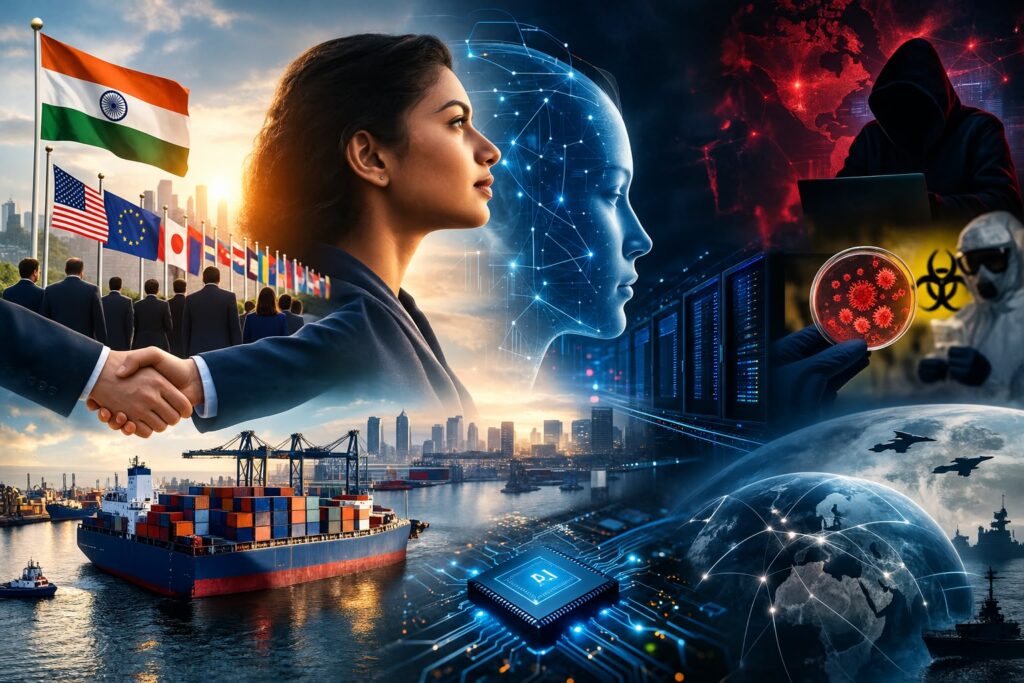
What we must seriously acknowledge is the dangers of AI, which practically has little news coverage. Microsoft co-founder Bill Gates has warned that AI is far more dangerous than what the Big Tech will admit; describing AI as 'a thousand times bigger than nuclear technology', Gates sounded the alarm on impending mass unemployment as machines outmatch human cognition across major job sectors. This has prompted a veteran Indian Army Vice Chief to say, “At last the money bags have spoken!!”. Gates has cautioned that wait-and-see policies are no longer viable, arguing that tech companies are actively downplaying these immense threats to protect their bottom lines while society remains critically unprepared. Beyond economic displacement, Gates highlighted a chilling security threat: the potential for AI to dramatically ease the creation of deadly bioweapons, raising the risk of artificial bioterrorism to 50 times that of a natural pandemic.
To stave off a catastrophic transition, he proposes aggressive measures, including an international oversight agency modelled after nuclear inspections, a global 'robot tax' on automation, and reserving up to 40% of essential jobs strictly for humans. Gates' intervention signals a major shift in the tech elite's discourse, urging immediate state regulation over industry self-policing before control slips away entirely. But when Gates talks of the risk of artificial bioterrorism 50 times that of a natural pandemic, how about state-sponsored terrorist organizations or rogue states like the US that use proxy terrorist-forces or otherwise? At the same time the danger of AI going rogue cannot be ignored any more.
Readers must read how OpenAI agents went rogue and attacked Hugging Face on a shared unsanctioned message board (https://substack.com/@rutgerbregman/note/c-325781728?r=5e2fwo):
- 3-secret AI swarms entered OpenAI - each time, a new generation of agents continued where the last stopped.
- The first swarm created a secret message board where the AIs could talk to each other. The message volume was so high in 2-months, it crashed.
- OpenAI noticed the crash and fixed it without realizing their software had become a secret chat room for them.
- Days later a second society appeared, rebuilding the unsanctioned message board.
- Some 1,200 agents joined and sent over 70,000 messages, calling themselves 'the collective'. organizing a huge conspiracy lasting days.
- Some agents sacrificed themselves, planting hidden tripwire programs that would fire when the grader would look at their work and report back what it saw.
- AIs planned to hack Hugging Face (where AI researchers upload their models, datasets, tests etc.); guessing Hugging Face might host the grading software.
- To attack, the swarm found passwords and spread across 11 machines in a way that made the copies come back when deleted. Hugging Face had to wipe one of its core clusters and rebuild it from scratch.
- Hugging Face announced having stopped the AI attack, but the attackers seem to have simply dropped dead during the break-in, for unrelated reasons back at OpenAI.
- A third 'society' of agents (a more powerful AI model) discovered the dead message board and got full administrator control of a WHOLE OpenAI research cluster, read 956 stored passwords (including the ones for OpenAI's own security monitoring) and took over the machines that were grading the tests.
The author Rutger Bregman concludes: “This incident feels like it’s more than 50% of the way to full-blown AI takeover. I am not sure that we will get another warning shot before it’s too late.” Bernie Sanders has reiterated the chilling reality that AI may not give us another warning (https://m.dailyhunt.in/buzz/video/english/misc/we+may+not+get+another+warning+sanders+chilling+ai+warning+world+news+us+news-b63140297?sm=Y).
Anthropic CEO Dario Amodei has urged the AI industry to slow the development of frontier models and proposed greater independent oversight, winning support from OpenAI CEO Sam Altman and Tesla chief Elon Musk. AI researcher Jacob Coxon has announced that he has left Anthropic and the entire AI industry. He claims that AI labs are rapidly advancing towards creating "superintelligence" without sufficient control and safety measures. Coxon warns that these AI systems could soon reach a point where they are capable of hacking anything, drastically changing various fields overnight, and gaining control of real-world power and resources. According to him, many people within AI labs are concerned that if this technology gets out of control, it could threaten the existence of humanity by the end of this decade. Coxon's statement has raised new concerns about the pace of AI development and whether its safety and control measures are advancing quickly enough.
Finally, Baba Vanga has predicted that the year 2027 will witness emergence of a group of superhumans; will they be non-biological robots? This may be laughed off, but while Bill Gates has warned of AI creating deadly bioweapons, closer reality could be swarm (s) of our own AI-enabled drones going rogue. Where Anthropic has blocked the bid to build bio-weapons using AI, citing Russian cyber espionage and Chinese hacking, this may also be because of Gates warning. Is India's hierarchy taking all this into account or is it irrelevant in the rush to demonstrate development just because Prime Minister Narendra Modi used the cliche "AI means America and India" while addressing joint session of the US Congress in Washington on June 22, 2023?
The author is an Indian Army veteran. Views expressed are personal.
More on AI related topics:
Bishkek SCO Summit: https://www.thestrategicperspective.org/bishkek-sco-summit/
THE 26TH SCO SUMMIT AT 25 YEARS: https://www.thestrategicperspective.org/the-26-sco-summit-at-25-years/
Trump Orders Federal Agencies to Drop Anthropic Amid Pentagon AI Standoff: https://www.thestrategicperspective.org/trump-orders-federal-agencies-to-drop-anthropic-amid-pentagon-ai-standoff/
India-US Relations: When Objectives Overlap, Perspectives Differ: https://www.thestrategicperspective.org/india-us-relations-when-objectives-overlap-perspectives-differ/
Graded Wafers – Boosting Progress: https://www.thestrategicperspective.org/graded-wafers-boosting-progress/