
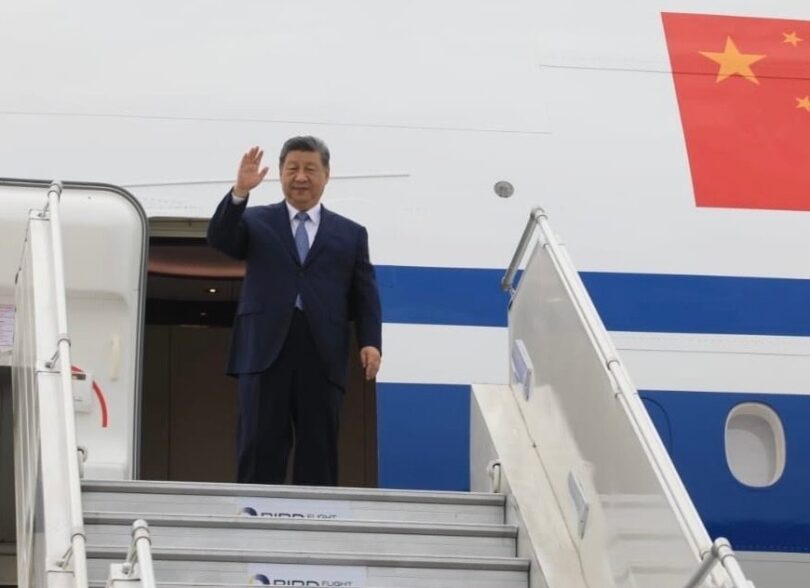

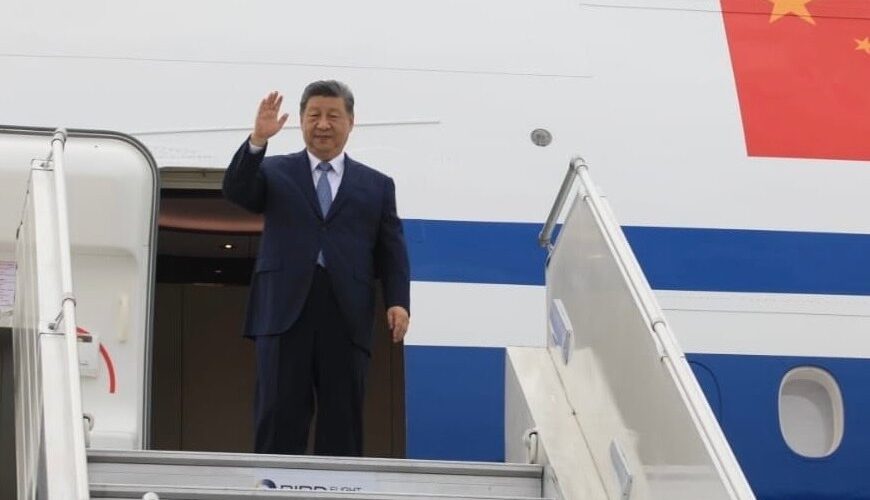
Chinese President Xi Jinping departed Beijing on Saturday morning to attend the 18th BRICS Summit in New Delhi, embarking on his first visit to India in almost seven years. This is marked as his notable visit to India since his last having been at the October 2019 informal summit with Prime Minister Narendra Modi at Mamallapuram, near Chennai.
The interim between Xi Jinping’s two visits marks the most critical and volatile phase in the modern Sino-Indian relations. This era was defined distinctly by the Galwan clash in eastern Ladakh in June 2020, which was a multi-year military standoff along the Line of Actual Control (LAC). The subsequent process of normalization in Sino-Indian ties has been slow to thaw and remains in flux.
On the eve of Xi’s arrival in India, the effect of the unresolved Sino Tibetan conflict manifested not in the corridors of Bharat Mandapam, but on the streets of North Delhi’s Tibetan quarter.
The Protest at Majnu Ka Tila
On the morning of 11 September 2026, a massive turnout of Tibetans assembled at the Samyeling Tibetan Settlement in Majnu Ka Tila for a procession march organized by the Tibetan Youth Congress (TYC).
Unlike prior demonstrations, this was not a generic anti-China protest which has been witnessed accompanying almost every Chinese leader's visit to India. Xi's own 2014 state visit and his 2016 trip for the Goa BRICS summit, as well as Foreign Minister Wang Yi's 2014 trip, drew comparable scenes at Majnu Ka Tila and elsewhere in Delhi.
The recent demonstration was the result of China's “Ethnic Unity and Progress Promotion Law,” which came into effect on 1 July 2026. Protesters carried placards and banners reading “Ethnic Unity Law and Progress = Genocide”.
Describing the law as “one of the most serious threats to the survival of Tibetan identity in recent decades,” the TYC public statement blamed Beijing of masking institutionalized assimilation as a promotion of ethnic unity. The group explicitly utilized Xi Jinping’s own pomegranate-seed metaphor, traditionally used by the state to signify a unified multi-ethnic nation to reiterate its stance against the regime.
Prior to the enactment of the law, Sikyong Penpa Tsering, the elected political head of the Central Tibetan Administration (CTA), had warned that it “may constitute a further step towards genocide”.
Several serving and former Tibetan political figures such as former CTA minister Gyari Dolma, former Tibetan parliamentarian Acharya Yeshi Phuntsok, and sitting members of the Tibetan Parliament-in-Exile Wangdue Dorjee, Gyaltsen Choekyi and Kunchok Migmar assembled at the demonstration. Dorjee boldly told the reporters, “We do not welcome Xi Jinping. He has occupied Tibet... If India wants security, then Tibet must be free”. This a formulation that explicitly links the Tibet issue to India's own border-security apparatus rather than treating it as a purely humanitarian appeal, he insinuated.
A separate and more confrontational action took place nearer the summit venue itself. Students for a Free Tibet (SFT) staged a demonstration in close pproximity to Bharat Mandapam at Pragati Maidan at around 7:30 a.m. on 10 September 2026, during which three Tibetan youth activists, a Tibetan journalist and an Indian college student working as a photographer unfurled banners critical of Xi and displayed Tibetan national flags. Delhi Police detained the five individuals according to SFT India's national director Tenzin Passang. According to reports, the three Tibetan activists were moved from Mandir Marg police station to Tihar Jail under preventive detention, expected to last through the summit period.
It is imperative to mention, the TYC's Majnu Ka Tila march was a permitted, escorted demonstration in the Tibetan settlement itself while the SFT action nearer the summit venue resulted in detentions. Some early Wire coverage conflates the two locations and dates, this account follows Phayul's and ANI's on-the-ground reporting, which separate them by both venue and day (10 September at Pragati Maidan; 11 September at Majnu Ka Tila).
How the Timing Sharpens the Message
The broad extraterritorial scope of China’s Law on Promoting Ethnic Unity and Progress since the 2018 Xinjiang campaign has received an intense pushback from Tibetan exile groups. By purporting to criminalize overseas dissent, the law directly threatens diaspora populations in India, home to both the largest Tibetan exile community and the Dalai Lama’s headquarters in Dharamshala as well as the respect for the Indian sovereignty.
Seizing upon India’s unique status as a haven for free political expression, the TYC timed its campaign to coincide with Xi’s first visit to New Delhi since the law’s passage. The group issued a direct appeal, calling on New Delhi, global democracies, and the UN Human Rights Council to oppose China’s assimilationist agenda and press for a full repeal.
Xi's Visit: The Diplomatic Context
On 10 September 2026, the Chinese Ministry of Foreign Affairs confirmed Xi’s attendance at the 18th BRICS Summit at Modi's invitation.
Xi's delegation includes Cai Qi, a member of the Communist Party's Politburo Standing Committee and director of the General Office of the CPC Central Committee, and Foreign Minister Wang Yi, both signalling the weight Beijing.
A Modi-Xi bilateral meeting was scheduled for the afternoon of 13 September at Bharat Mandapam.
This is the third consecutive year, when the two leaders will meet in person, following side-line talks at the 2024 Kazan BRICS summit and the 2025 Shanghai Cooperation Organisation summit in Tianjin. At Tianjin, the two leaders had reaffirmed that India and China were “development partners and not rivals” and that “differences should not turn into disputes”.
The steps that made this meeting possible
October 2024: agreement on patrolling arrangements in the Depsang and Demchok sectors of eastern Ladakh, ending the most acute phase of the post-Galwan standoff.
October 2025: resumption of direct flights between the two countries, suspended since 2020.
Restarting of tourist visas for Chinese nationals and eased business-visa procedures.
March 2026: Union Cabinet revisions to Press Note 3 permitting automatic-route investment from land-bordering countries (i.e., China) with non-controlling beneficial ownership up to 10%, and fast-tracked 60-day processing for select manufacturing-sector investment proposals.
Partial and eventual relaxation of China's export curbs on tunnel-boring machines, fertilisers and rare-earth magnets — the last of these tied explicitly to Wang Yi's visit to Delhi and his meeting with External Affairs Minister S. Jaishankar.
The Unresolved Layer Beneath the Thaw
Reema Bhattacharya of Verisk Maplecroft has described the thaw as “tactical and fragile,” driven substantially by both countries' shared exposure to U.S. tariff pressure rather than by a genuine convergence of strategic interest. This remains a common inference deduced from Trump's tariff threats against both India and China.
Three structural factors remain unresolved beneath the diplomatic developments:
- The trade and trust deficits
Bilateral trade reached a record USD 155.6 billion in 2025, but India's deficit with China climbed to roughly USD 116 billion. This is approximately 10% of China's entire global trade surplus. Separate reporting places India's China imports at USD 80 billion in the first half of 2026 alone, with the deficit still widening despite anti-dumping duties imposed by India on select Chinese machinery categories.
One framing worth flagging: analysts increasingly describe this as two distinct deficits — a trade deficit rooted in India's dependence on Chinese manufacturing inputs (from active pharmaceutical ingredients to electronics), and a harder-to-close “trust deficit” rooted in Galwan and in China's continuing defence relationship with Pakistan.
- Rare-earth dependency
Over 90% of India's rare-earth magnets and metals are sourced from China, a dependency that has repeatedly surfaced as a point of leverage — most visibly when China's global rare-earth licensing curbs (effective 1 December 2025) forced high-level intervention, including an August 2025 meeting between Wang Yi and India's National Security Advisor Ajit Doval at which Beijing pledged to address India's rare-earth needs.
India's own countermeasure, an approved USD 800 million programme (November 2025) to build domestic rare-earth magnet capacity — indicates New Delhi is hedging against, rather than resolving, this dependency even as short-term supply curbs ease.
- The Pakistan factor and the border itself
China's increasing defence relationship with Pakistan which also includes Pakistan's deployment of Chinese-supplied fighter jets during its clash with India in the past year continues to drive wedge in New Delhi's China calculus regardless of border-patrolling arrangements. The 3,488-kilometre LAC itself remains only partially disengaged rather than resolved. Both governments continue to characterise the border situation as “stable” and improved from its post-2020 nadir but not settled.
Concluding remarks
Xi's presence in New Delhi, and the scheduled third consecutive Modi-Xi bilateral may be viewed as a thaw post the Galwan freeze. This may be seen as a way for both nations to have somewhat of a managed and functional relationship — one in which both governments have concluded that the cost of open antagonism now outweighs the benefit, particularly with both facing simultaneous pressure from Washington on trade.
It would be premature to ascertain these new developments as a complete strategic reset rather than a situational at the moment. Manoj Kewalramani of the Takshashila Institution frames the realistic best case as a possible “framework for dialogue on trade and investment,” not a resolution of the underlying disputes.
For BRICS itself, the persistence of India-China rivalry is treated by outside analysts as a structural constraint rather than a passing irritant.
The matter of Tibet question sits awkwardly inside this calculus. India has avoided using Tibet as explicit diplomatic leverage against Beijing.
The TYC's direct appeal to “the Government of India” to press for repeal of the ethnic-unity law is, in effect, a request that New Delhi make a policy choice it has consistently declined to make even at moments of high bilateral tension.
More on China-India relations:
Arunachal Calling: https://www.thestrategicperspective.org/arunachal-calling/
THE 26TH SCO SUMMIT AT 25 YEARS: https://www.thestrategicperspective.org/the-26-sco-summit-at-25-years/
Trump, Hormuz, and Strategic Exaggeration: https://www.thestrategicperspective.org/trump-hormuz-and-strategic-exaggeration/
Defending the Siliguri Corridor: Securing India’s Strategic Lifeline to the Northeast: https://www.thestrategicperspective.org/defending-the-siliguri-corridor-securing-indias-strategic-lifeline-to-the-northeast/
China’s Water Threats, India’s Malacca Leverage and Growing Indo-Pacific Contestation: https://www.thestrategicperspective.org/chinas-water-threats-indias-malacca-leverage-and-growing-indo-pacific-contestation/
Enforcing 'Ethnic Unity' in China: New 'National Identity' Law has Implications for Dalai Lama Succession and Tibetan Diaspora: https://www.thestrategicperspective.org/enforcing-ethnic-unity-in-china-new-national-identify-law-has-implications-for-dalai-lama-succession-and-tibetan-diaspora/
Voices from Beijing: https://www.thestrategicperspective.org/voices-from-beijing/