

Executive Summary
- On 23 September 1918, the Jodhpur Lancers of the 15th (Imperial Service) Cavalry Brigade launched a legendary mounted charge on entrenched German-led machine-gun and Austrian artillery positions defending the port of Haifa, on the northern flank of General Allenby's Battle of Megiddo offensive.
- The Jodhpur Lancers' commanding officer, Major Thakur Dalpat Singh Shekhawat, was martyred leading the manoeuvre around the Kishon River and is remembered as the “Hero of Haifa”. He was posthumously awarded the Military Cross.
- The regiment was raised by Sir Pratap Singh of Idar, who raised the Sardar Rissala in 1889 on an explicitly Rajput martial ethos — a lineage the 61st Cavalry, one of the world's last operational horse-mounted regiments, still carries today.
- The battle's memory is remembered during the Indian and Israeli commemoration. 23 September is marked as Haifa Day by the Indian Army. On January 2018 Delhi's Teen Murti Chowk was formally renamed Teen Murti-Haifa Chowk by Prime Ministers Modi and Netanyahu.
- The Rajput Tradition and the Making of an Elite Force
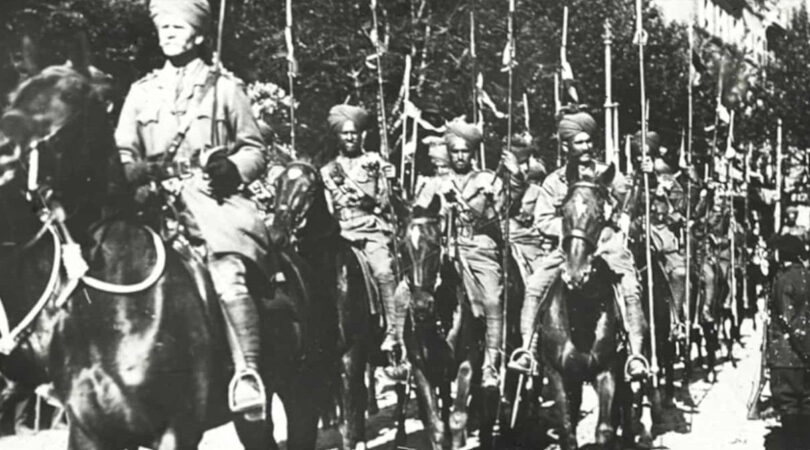
The origin of the Jodhpur Lancers can be traced to 1889, when the Government of India under the British Raj requested the princely states to raise Imperial Service Troops for fighting alongside the British Indian Army beyond the North-West Frontier. At the time, Sir Pratap Singh, third son of Maharaja Takhat Singh of Marwar (Jodhpur), and by then regent of the state, answered the call personally, forming a small mounted force, the Sardar Rissala, which swiftly grew into a full regiment of some three hundred horsemen.
General Sir Frederick Roberts, commander-in-chief in India, has been recorded praising both the cavalry and the Rajput clansmen who filled its ranks, for whom, “izzat” (honour) was “dearer than life” and loyalty and self-sacrifice were taken as given rather than aspired to.
Pratap Singh had himself fought alongside the British Indian forces in the Second Afghan War of 1878–80, where he was mentioned in despatches. He later commanded the Jodhpur contingent sent to suppress the Boxer Uprising in China in 1900. This is regarded as the regiment's baptism under fire outside South Asia.
By the early twentieth century the Jodhpur Lancers had become, in the words of one regimental history, among “the best-known and most glamorous regiments in India” their reputation resting as much on the ferocious equestrianism of Sir Pratap's Rathore so in wars as on parade-ground spectacle.
The regiment's motto by the end of the Great War would become “Jo Hukum” — “As you command”, a name soldiers of the brigade earned, according to regimental historian Michael Creese because “no challenge was insurmountable, no order ever refused.” That reputation for absolute, uncomplaining obedience under fire is precisely what would be asked of B Squadron on the slopes above Haifa in September 1918.
From Tirah to Flanders: A Reputation Built Before Haifa
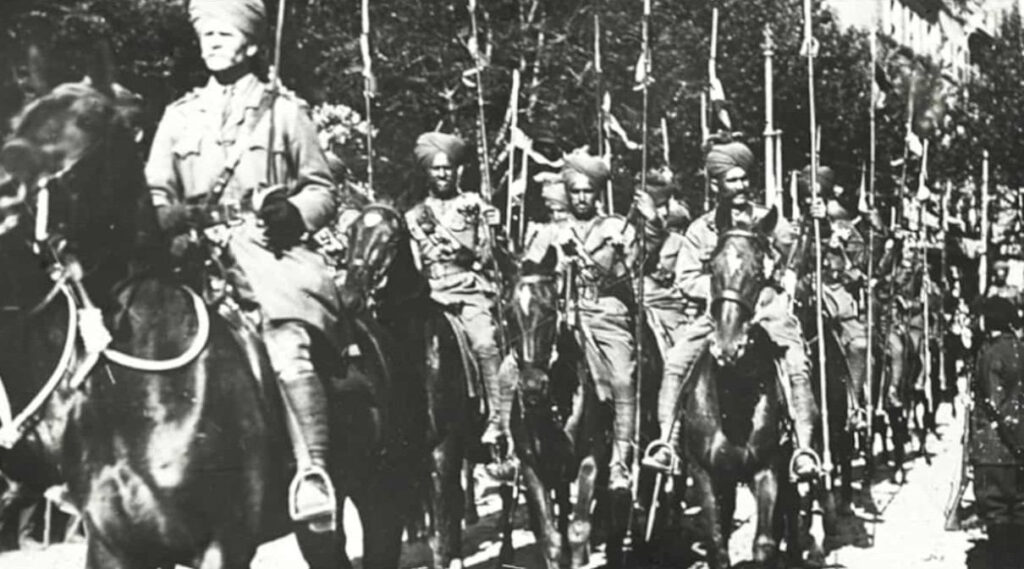
When the WWI broke out in August 1914, Sir Pratap , a soldier in his late sixties immediately offered to lead the Jodhpur Lancers to France. Despite the warnings that trench conditions left little scope for a mounted charge, he confidently responded saying “I will make an opportunity!”
In October 1914, the regiment arrived in Flanders, remaining on the Western Front for over three years in the trenches through the worst of positional warfare on the Somme and at Cambrai, alongside Neuve-Chapelle earlier in the war. The unglamorous, attritional service far removed from the charge with which the regiment is now most associated.
Sir Pratap Singh's personal conduct in this period became part of regimental lore. Several accounts describe him for restraining his men from using the sharpened point of the lance until he personally drew first blood, so that the honour of striking the first blow would fall to the commanding officer rather than any trooper. He was promoted major-general and appointed an honorary Knight Commander of the Bath, and in 1916 rose to lieutenant-general. This made him one of the oldest serving officers in any combatant army.
Into Palestine: The Desert Mounted Corps, 1918
In 1918, with trench deadlock still gripping the Western Front, the Lancers were transferred from France to Egypt to join the Desert Mounted Corps under General Sir Edmund Allenby, forming part of the 5th Cavalry Division's 15th (Imperial Service) Cavalry Brigade.
Here, in the more open terrain of the Sinai and Palestine campaign, cavalry could once again manoeuvre and strike as cavalry. The brigade's first serious challenge came at the Affair of Abu Tellul on 14 July 1918. This is where the 15th Brigade fought alongside the Australian 1st Light Horse Brigade to repulse a German-supported Ottoman attack, inflicting roughly a thousand casualties and taking between 425 and 540 prisoners for a loss of 23 killed and 46 wounded among the Australian light horsemen engaged.
The action at Abu Tellul was an important one - it determined what followed at Haifa. It proved the effectiveness of the 15th Brigade's Indian regiments as a fighting formation under modern conditions, and it gave Allenby's staff confidence that Imperial Service cavalry raised and largely officered by Indian princely states rather than the regular British Indian Army could be trusted with an independent, decisive role in the general offensive he was about to launch.
The Road to Haifa: 19–22 September 1918
The Battle of Haifa was fought on 23 September 1918 at the tail end of the Battle of Sharon, itself part of Allenby's set-piece Battle of Megiddo (19–25 September), the offensive that broke the Ottoman Seventh and Eighth Armies and effectively ended organised Ottoman resistance in Palestine.
With the Ottoman armies outflanked and retreating northward through the Judean Hills, capture of the port of Haifa had become urgent. The roads inland were little more than tracks, and only a working port could land the supplies Allenby's advancing forces needed.
Early attempts to take the town met unexpectedly stiff resistance. Soon after midnight on 21/22 September, the 18th King George's Own Lancers of the 13th Cavalry Brigade routed an Ottoman battalion on the Acre road, taking over 200 prisoners. On 22 September, aerial reconnaissance wrongly reported Haifa evacuated, and a follow-up column was stopped by accurate Ottoman artillery and machine-gun fire. An armoured-car patrol probing the approach found a strong redoubt 200 yards from the Haifa road and, two miles further on, an Austrian battery of light field guns backed by German machine gunners, held a position which was difficult to outflank as the Nahr al-Muqatta (Kishon River) was bounded impassable marsh on either side.
The 5th Cavalry Division was ordered to take Haifa and Acre the following day.
The ground favoured the defender absolutely as a narrow corridor pinched between the steep, gun-studded slopes of Mount Carmel to the south and quicksand-laced marshland to the north.
According to accounts from surviving Jodhpur Lancers officers, the position was defended by roughly a thousand Ottoman troops, equipped with fifteen artillery pieces and several machine guns. It was a formidable, natural bastion and one that no rational staff officer in 1918 would have dared to assault with cavalry alone.
The Charge, 23 September 1918
The plan divided the brigade's work in two. A squadron of the Mysore Lancers, together with a squadron of the Sherwood Rangers Yeomanry and supported by B Battery, Honourable Artillery Company, was to climb a steep track onto the slopes of Mount Carmel and silence the Austrian field guns positioned there, while the Jodhpur Lancers delivered the main mounted attack on the German machine-gun line blocking the road into Haifa.
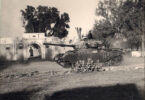
The two actions commenced at around 14:00 hours. The Jodhpur Lancers advanced at the trot, crossing the Acre railway line and coming under machine-gun and artillery fire. Deterred by quicksand along the Kishon's banks, the regiment wheeled left onto the lower slopes of Mount Carmel while the rest of the brigade laid down suppressive fire to cover the manoeuvre. During this exposed wheeling movement, Major Dalpat Singh Shekhawat, commanding officer of the Jodhpur Lancers, was hit by machine-gun fire and was gravely wounded.
With over thousand Turks with fifteen cannons and several machine guns, the leading B Squadron galloped straight at them, and killed them.
Regimental account, cited in M.S. Jodha, The Story of the Jodhpur Lancers
B Squadron — composed solely of Rathore clansmen — pressed the charge home, overrunning the machine-gun detachment and capturing thirty prisoners, two machine guns and two camel guns, opening a route into the town itself.
The Jodhpur Lancers then rode on into Haifa, taking the defenders by surprise while the Mysore Lancers, having provided covering fire from the heights, mounted up and followed them in.
Between them the two regiments took approximately 1,350 German and Ottoman prisoners , including two German officers and 35 Ottoman officers — along with seventeen artillery pieces (among them four 4.2-inch guns, eight 77mm field guns and four camel guns), a six-inch naval gun and eleven machine guns.
A captured German officer's own account, recorded after the battle, offers a measure of how completely the defence collapsed: “We tried to cover the Turks' retreat, but we expected them to do something, if only keep their heads. At last we decided they were not worth fighting for.”
Strategic Consequences: Opening the North
The capture of Haifa was far important than the tactical action itself. It cleared a much needed strategic port through which Allenby's advancing forces could land supplies. With their lines of supply and retreat cut by the Desert Mounted Corps, the Ottoman Seventh Army and the remnants of the Eighth were forced onto minor roads and tracks east across the Jordan toward the Hejaz railway. By 25 September, one Ottoman army had effectively eliminated and the other two retreated towards Damascus. Allenby himself, reporting to the War Office on 25 September, noted that prisoner numbers from the whole offensive already stood at “well over 40,000 and still coming in,” and set in motion the cavalry advance that would take Damascus within the week and Aleppo by late October. The Jodhpur Lancers pushed on through further actions at Damascus and the Affair of Haritan on the road to Aleppo.
Legacy: From Sardar Rissala to the 61st Cavalry
The Jodhpur Lancers returned to France after the battle at Haifa and later, in the Second World War, exchanged their horses for Bren-gun carriers. It is the same mechanisation that ended horsed cavalry as a fighting arm across every modern army.
Following Indian independence and the integration of the princely states' forces after 1947, the various Imperial Service cavalry units, including the Jodhpur Lancers, Mysore Lancers, Gwalior Lancers and several smaller state contingents were amalgamated in 1953 into a single new formation, the 61st Cavalry, raised at Jaipur under Lieutenant-Colonel Phulel Singh.
The 61st Cavalry is today one of the very last operational horse-mounted cavalry regiments in the world, alongside Britain's Household Cavalry Mounted Regiment and Russia's 11th Cavalry Regiment, performing largely ceremonial duties — most visibly at India's annual Republic Day parade — while recruiting, as its forebear did, from Rajput, Maratha and Kaimkhani communities.
The regiment carries “Haifa” as a formal battle honour and still marks 23 September each year as its Raising Day, or Haifa Day — a direct, unbroken thread from the Sardar Rissala Sir Pratap Singh raised in 1889 to the ceremonial cavalry that guards the Republic today.
Living Memory: Haifa Day and the India–Israel Bridge
The Imperial Service Cavalry Brigade Memorial display three life-size bronze statues representing the Hyderabad, Jodhpur and Mysore Lancers. The memorial was unveiled on the Teen Murti roundabout in New Delhi in March 1924. On 14 January 2018, marking the war's centenary, Prime Minister Narendra Modi and Israeli Prime Minister Benjamin Netanyahu jointly presided over the formal renaming of the site as Teen Murti-Haifa Chowk, laying a wreath and signing the visitors' book.
In Haifa itself, the battle is marked with an annual ceremony at the city's British military cemetery, attended in recent years by the Haifa mayor and Indian diplomatic and defence representatives.
One Israeli historian referred to battle of Haifa as “a living testament to the power of heritage to unite two nations.”
The connection carries an unexpected humanitarian footnote as well: in the months before the assault, the Ottoman commander Jamal Pasha had threatened to execute the Bahá'í leader 'Abdu'l-Bahá on the slopes of Mount Carmel, prompting British concern at the highest level.
The Lancers' rapid capture of the city removed the threat, and the Bahá'í World Centre's Shrine of the Báb stands today on Mount Carmel, overlooking the very ground the charge crossed — a coincidence of geography that Indian and Bahá'í commemorations alike have since drawn on.
Conclusion
The cost of that success, borne overwhelmingly by Rajput troopers of B Squadron and paid in the life of their own commanding officer, is inseparable from what makes the action worth remembering as more than a curiosity of military history.
“Such raw courage the world had rarely seen. Nor had death and pain ever been treated with such disdain.
Here were descendants of men who had fought at Khanua and Sumel and Dharmat and Merta and Malpura, all legendary Rathore charges, but this was perhaps the finest of them all. Indeed this charge at Haifa is described by many as the most remarkable cavalry action ever in the history of war and, as the historian Charles C.Trench remarks in his book, ‘The Indian Army and the King’s Enemies’. “Only the Jo Hukums could have done it.”