

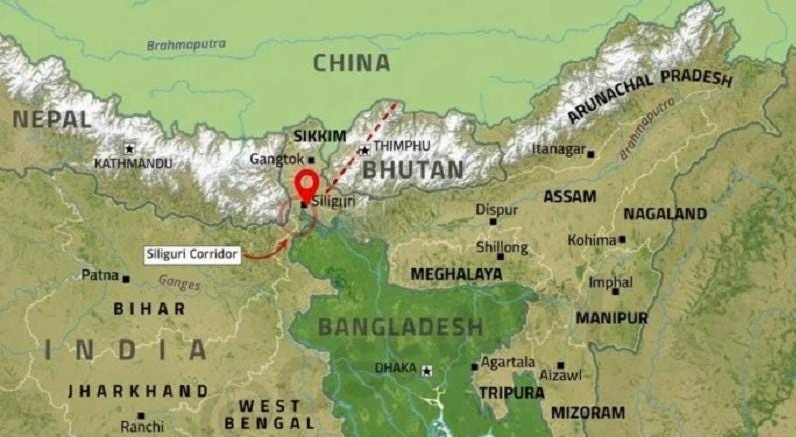

Every military planner is taught that geography can be both a nation’s greatest ally and its greatest vulnerability. There are places where history, topography and geopolitics converge to create strategic fault lines whose significance far exceeds their physical dimensions. The Siliguri Corridor is one such place.
Imagine, for a moment, a future crisis on India’s northern frontier. Hostilities have escalated rapidly along the Himalayas. Long-range precision missiles begin targeting railway junctions, bridges and fuel depots around Siliguri. Cyber attacks cripple signalling systems. Simultaneously, heavy artillery and long-range rocket systems operating from the Tibetan plateau place the corridor under sustained fire. Even without crossing into Indian territory in large numbers, an adversary succeeds in severing the principal land routes connecting the Indian mainland with the eight northeastern states.
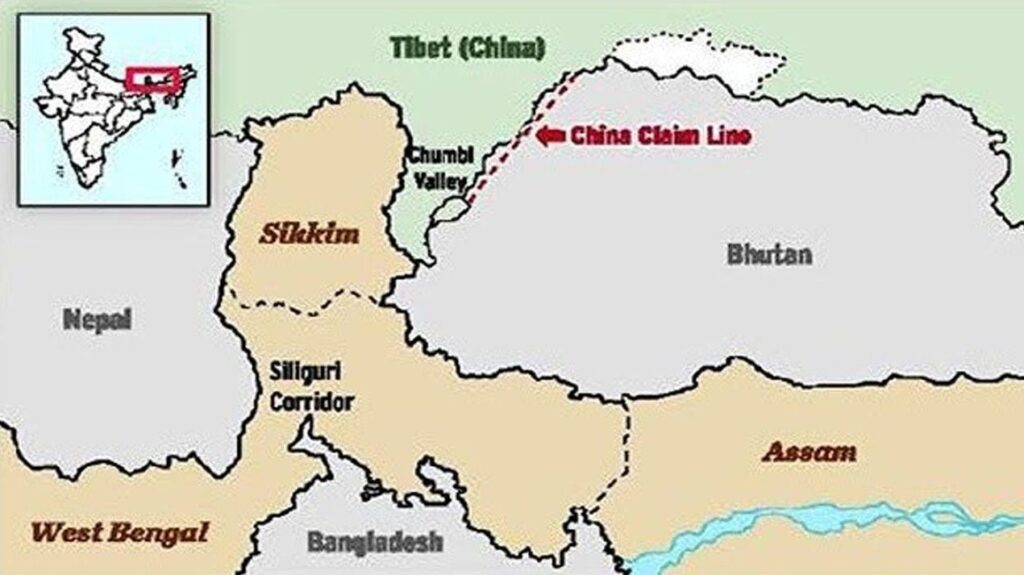
In a matter of hours, over fifty million Indian citizens find themselves geographically isolated from the rest of the country. Reinforcements, ammunition, fuel, food supplies and commercial traffic are forced onto far longer and less efficient routes. The military challenge immediately transforms into a national strategic crisis. This is not an exercise in alarmism. It is a realistic appreciation of geography.
The Siliguri Corridor, often referred to as India’s “Chicken’s Neck”, is approximately sixty kilometres in length and barely twenty to twenty-two kilometres wide at its narrowest point. To its northwest lies Nepal. Bhutan forms its northern flank. Bangladesh borders it to the south, while further north rises the formidable Himalayan barrier leading into Tibet under Chinese control. Few countries in the world possess such a narrow land bridge connecting one-third of their territory with the national heartland.
The importance of this corridor extends far beyond logistics. It is the arterial link connecting Arunachal Pradesh, Assam, Meghalaya, Manipur, Mizoram, Nagaland, Tripura and Sikkim with the rest of India. Every military convoy, petroleum pipeline, fibre optic cable, railway line, electricity grid and commercial supply chain converges upon this narrow geographical bottleneck. Consequently, defending the Siliguri Corridor is not merely a border management task. It is an existential requirement for preserving India’s territorial integrity and strategic cohesion. Success demands far more than military deployments. It requires a carefully integrated national strategy combining military preparedness, infrastructure resilience, diplomatic engagement and regional connectivity.
Historical Genesis and Geopolitical Gravity
The strategic importance of the Siliguri Corridor is not an ancient geographical reality but a relatively modern geopolitical creation. Before Partition in 1947, India’s northeastern region enjoyed multiple communication links through Bengal and what later became East Pakistan. Railways, highways and riverine networks connected Assam to Calcutta through relatively direct routes. Partition fundamentally altered this geography.
The creation of East Pakistan abruptly severed these traditional lines of communication, compressing India’s access to the Northeast into the narrow strip around Siliguri. Overnight, what had once been merely another district in North Bengal became one of the world’s most strategically sensitive corridors. This vulnerability became starkly evident during the 1962 Sino-Indian War. India’s ability to reinforce its eastern theatre depended almost entirely upon transportation through this narrow neck of land. The war exposed severe deficiencies in logistics, road construction and force mobilisation. More importantly, it demonstrated that geographical vulnerabilities could rapidly become operational liabilities.
Since then, every major defence review concerning India’s eastern theatre has regarded the security of the Siliguri Corridor as a strategic imperative. The emergence of China as India’s principal military competitor has only magnified these concerns. Immediately north of Bhutan lies the Chumbi Valley, a narrow wedge of Tibetan territory extending southward between Sikkim and western Bhutan. On the map, it resembles a dagger pointing directly towards the Siliguri Corridor. From its southern extremity to the corridor is roughly 130 kilometres. Military geography matters because it shapes options.
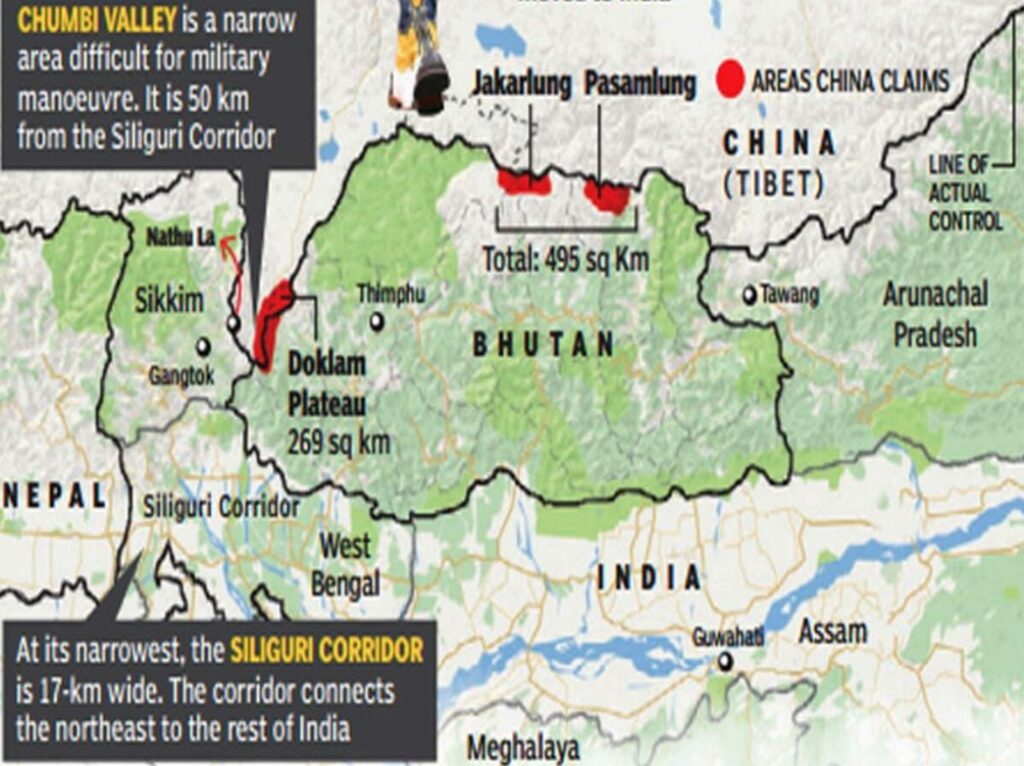
The Chumbi Valley provides China with interior lines of communication while simultaneously presenting India with converging axes of potential threat. Modern precision artillery, long-range rocket systems and air power have significantly reduced the relevance of physical distance. Today, an adversary need not physically occupy the corridor to render it operationally ineffective. This evolving character of warfare fundamentally alters the strategic calculus. The contest over Siliguri is no longer about territory alone. It is increasingly about controlling infrastructure, logistics and information networks across an integrated battlespace.
The Threat Matrix: Conventional and Hybrid Challenges
Military planning must always distinguish between capability and intent. Intent may fluctuate with political circumstances. Capabilities endure. China today possesses both the military capabilities and infrastructure necessary to place significant pressure upon India’s eastern theatre during a future conflict. A conventional offensive originating from the Chumbi Valley would almost certainly not resemble the massed infantry assaults associated with earlier Himalayan wars. Instead, any future campaign would likely involve integrated combined-arms operations supported by precision fires, cyber warfare, electronic warfare, space-based intelligence and unmanned systems.
The People’s Liberation Army would seek disruption rather than occupation. Long-range rocket artillery, precision-guided missiles and air-delivered stand-off weapons could target railway junctions, bridges, ammunition depots, petroleum storage facilities and command centres throughout the Siliguri region. The objective would be straightforward—to isolate India’s Northeast without becoming embroiled in costly urban or mountain warfare.
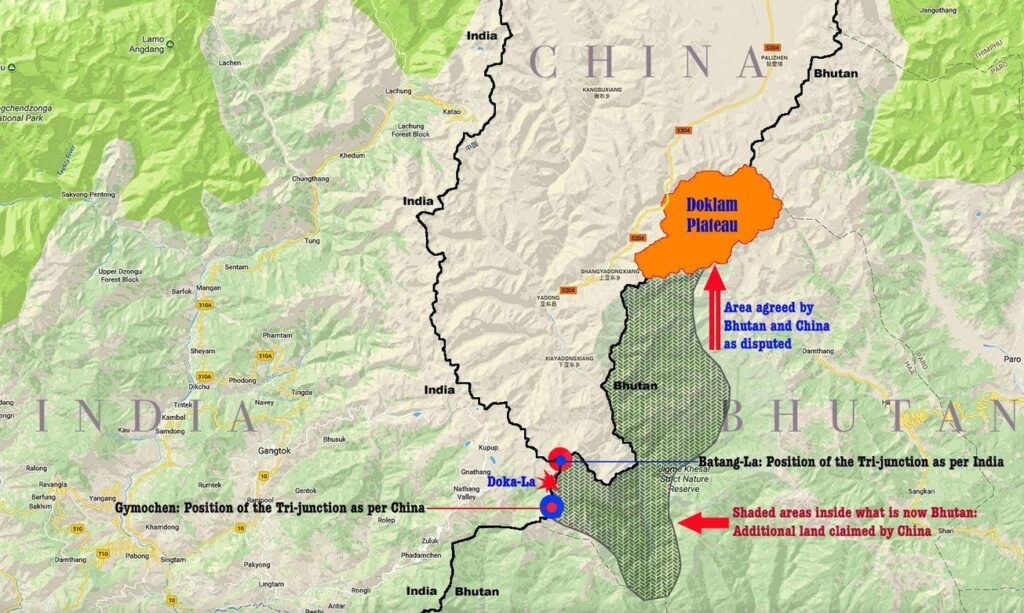
In this context, the Doklam Plateau assumes extraordinary significance. The 2017 Doklam standoff was never merely about the construction of a mountain road. China’s efforts to extend infrastructure towards the Jampheri Ridge would have enabled significantly improved surveillance and potentially enhanced military positioning overlooking approaches to the Siliguri Corridor.
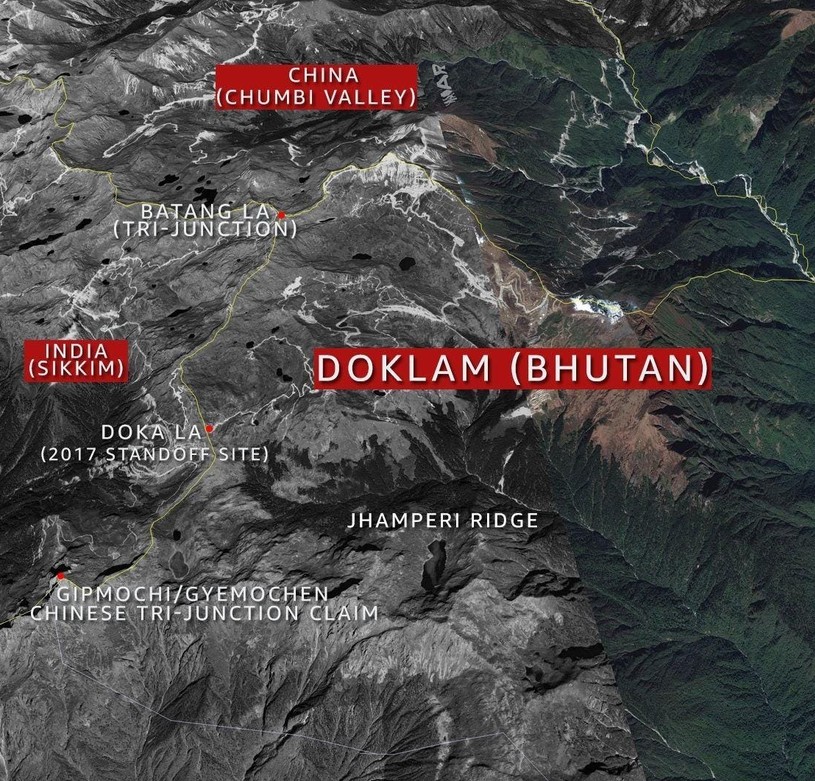
India’s intervention prevented an adverse alteration of the tactical geometry. The episode demonstrated an important principle often overlooked in public discourse. Strategic depth is not measured only in kilometres. It is measured in observation, mobility and terrain dominance. If an adversary gains control over commanding heights, defensive options contract rapidly. The threat, however, extends beyond conventional warfare. Hybrid conflict increasingly targets societies rather than armies. The Siliguri Corridor presents multiple vulnerabilities susceptible to asymmetric exploitation.
Critical railway bridges carrying military supplies remain attractive sabotage targets. Petroleum pipelines, electricity transmission lines, optical fibre networks and communication exchanges are all potential objectives during a crisis. Cyber attacks against railway signalling, financial networks and logistics management systems could achieve effects comparable to physical destruction. Demographic changes also introduce complex internal security challenges. Large-scale illegal migration, organised criminal networks, counterfeit currency operations and transnational trafficking have historically complicated security management in this region.
These issues are not simply law-and-order concerns. They possess strategic implications because they can generate internal instability precisely when national attention is focused on external conflict. Modern warfare increasingly blurs the distinction between peace and war. The Siliguri Corridor would almost certainly become a laboratory for this new form of integrated competition.
India’s Defensive Doctrine: Building the Military Shield
India’s response has evolved steadily from static border defence towards integrated theatre resilience. At the centre of this defensive architecture stands the Indian Army’s XXXIII Corps, headquartered at Sukhna. Tasked with securing Sikkim, North Bengal and adjoining sectors, the Corps represents one of India’s most experienced mountain warfare formations. Its responsibilities extend beyond conventional defence to include rapid mobilisation, counter-penetration operations and maintaining operational flexibility across extremely challenging terrain.
Supporting the Army are two critical border management forces. The Border Security Force secures the extensive India-Bangladesh frontier, preventing infiltration, smuggling and cross-border disruption. Along the India-Nepal frontier, the Sashastra Seema Bal performs the equally demanding task of managing one of the world’s most open international borders while facilitating legitimate movement and preventing hostile exploitation. Air power constitutes the second pillar of deterrence. A recently raised Area HQ in Silligur too has improved the overall command and control of various logistic forces in the area, leaving the fighting formations free to deal with the larger kinetic battle.
Hashimara Air Force Station has acquired exceptional strategic importance with the induction of the Rafale fighter aircraft. Combined with Bagdogra Air Force Station, these bases provide rapid air defence, offensive strike capability, reconnaissance and operational flexibility across the eastern theatre. The presence of advanced fighters armed with long-range air-to-air and precision strike weapons significantly complicates any adversary’s operational planning. In military terminology, they create an effective Anti-Access and Area Denial umbrella over much of the eastern sector.
Simultaneously, India has accelerated investments in surveillance. Persistent drone coverage, battlefield surveillance radars, satellite integration and networked command systems substantially reduce the likelihood of operational surprise. Permanent military infrastructure has expanded considerably. Forward logistics nodes, ammunition storage facilities, hardened command centres and improved road connectivity enhance sustainability during prolonged operations. The underlying philosophy is clear. Rather than relying solely upon reactive mobilisation, India increasingly seeks continuous readiness. Deterrence today depends less upon numbers and more upon preparedness, resilience and rapid response.
Overcoming the Single Point of Failure
No strategist willingly accepts a single point of failure. Consequently, India’s long-term solution extends well beyond defending Siliguri itself. The objective is to reduce dependence upon the corridor by creating alternative logistical arteries. The Kaladan Multi-Modal Transit Transport Project represents one such strategic investment. Connecting India’s eastern seaboard with Myanmar’s Sittwe Port before moving inland into Mizoram, Kaladan offers an entirely different axis of connectivity that bypasses the Siliguri Corridor.
The political changes in Bangladesh and the growing strategic footprint of China demand a reassessment of assumptions that until recently underpinned India’s eastern connectivity strategy. The optimism that accompanied unprecedented transit cooperation with Dhaka can no longer be treated as a permanent strategic constant. Access agreements, railway links, inland waterways and road corridors remain enormously valuable, but they must now be viewed through the prism of geopolitical uncertainty rather than political continuity. Reports of enhanced Chinese involvement in critical infrastructure, including the development and operational management of facilities such as Mongla Port, underscore Beijing’s broader strategy of embedding itself within the maritime and logistical architecture of the Bay of Bengal. While Bangladesh continues to pursue a policy of balancing its relationships with major powers, India can no longer afford to predicate the security of its Northeast on the assumption of uninterrupted access through Bangladeshi territory.
The appropriate Indian response is neither strategic alarmism nor diplomatic disengagement. Instead, New Delhi must adopt a policy of strategic hedging. Bangladesh should remain a close economic and developmental partner, with sustained investments in trade, energy cooperation, connectivity and people-to-people ties designed to preserve mutual interdependence irrespective of changes in political leadership. Simultaneously, India must accelerate the creation of parallel and sovereign alternatives that are immune to external political pressures. Projects such as the Kaladan Multi-Modal Transit Transport Project, the strengthening of internal road and rail corridors through the Northeast, the expansion of air logistics, and the development of additional riverine and coastal shipping infrastructure must now be treated not merely as developmental initiatives but as strategic insurance policies. The objective should be clear: We must convince Bangladesh to remain India’s preferred gateway to the Northeast, but never again should we allow it to become its only gateway. Strategic resilience lies not in dependence on a single route or partner, however friendly or unfriendly, but in possessing multiple options that ensure national connectivity under all political and military contingencies.
Within India, the Border Roads Organisation continues constructing additional highways, underpasses, bridges and dual-use infrastructure throughout the Northeast. Improved connectivity through Sikkim, expanded national highways, and enhanced tunnel networks provide valuable redundancy. The objective is straightforward. If one artery is disrupted, several others must remain functional. Infrastructure redundancy is no longer an economic luxury. It has become a strategic necessity.
The Diplomatic Buffer: Bhutan and Nepal
Military power alone cannot secure the Siliguri Corridor. Diplomacy provides the indispensable outer layer of defence. Bhutan occupies a uniquely important position. Its territory forms India’s northern shield against the Chumbi Valley. Continued strategic trust between New Delhi and Thimphu therefore remains central to India’s security calculus. The events at Doklam demonstrated that Bhutan’s sovereignty and India’s security are closely intertwined. I think India needs to move beyond conventional diplomacy and introduce the idea of strategic connectivity agreements. Rather than viewing Nepal and Bhutan merely as buffer states, India must view them as partners in regional resilience, while fully respecting their sovereignty.
Nepal and Bhutan are often described as India’s strategic buffers, but in the twenty-first century they should be viewed as strategic partners in resilience rather than passive geographical shields. While the open border with Nepal has facilitated centuries of civilisational, cultural and economic interaction, it has also created vulnerabilities that can be exploited by hostile intelligence agencies, transnational criminal networks and influence operations. The answer, however, does not lie in restricting this openness, but in transforming it into a strategic asset through deeper institutional cooperation, intelligence sharing, integrated border management and coordinated infrastructure planning. This is a must, and here, the Nepali-origin soldiers and ex-soldiers of the Indian army could play a critical role in being our ‘bridge over troubled waters’ if or whenever the political relations between India and Nepal deteriorate.
India should now initiate discussions with both Kathmandu and Thimphu on the creation of a Himalayan Strategic Connectivity Framework, a trilateral arrangement designed not for military deployment but for ensuring the uninterrupted movement of humanitarian assistance, essential commodities and strategic logistics during periods of national emergency. Such an arrangement could identify pre-designated road corridors that might need to be created now and planned for, through eastern Nepal and southern Bhutan that remain available, under mutually agreed protocols and with the explicit consent of the host governments, for emergency civilian and military logistics if the Siliguri Corridor were disrupted. Complemented by harmonised customs procedures, interoperable digital logistics systems, common disaster-response mechanisms and jointly developed transport infrastructure, these routes would provide India with critical strategic redundancy without compromising the sovereignty or neutrality of either neighbour.
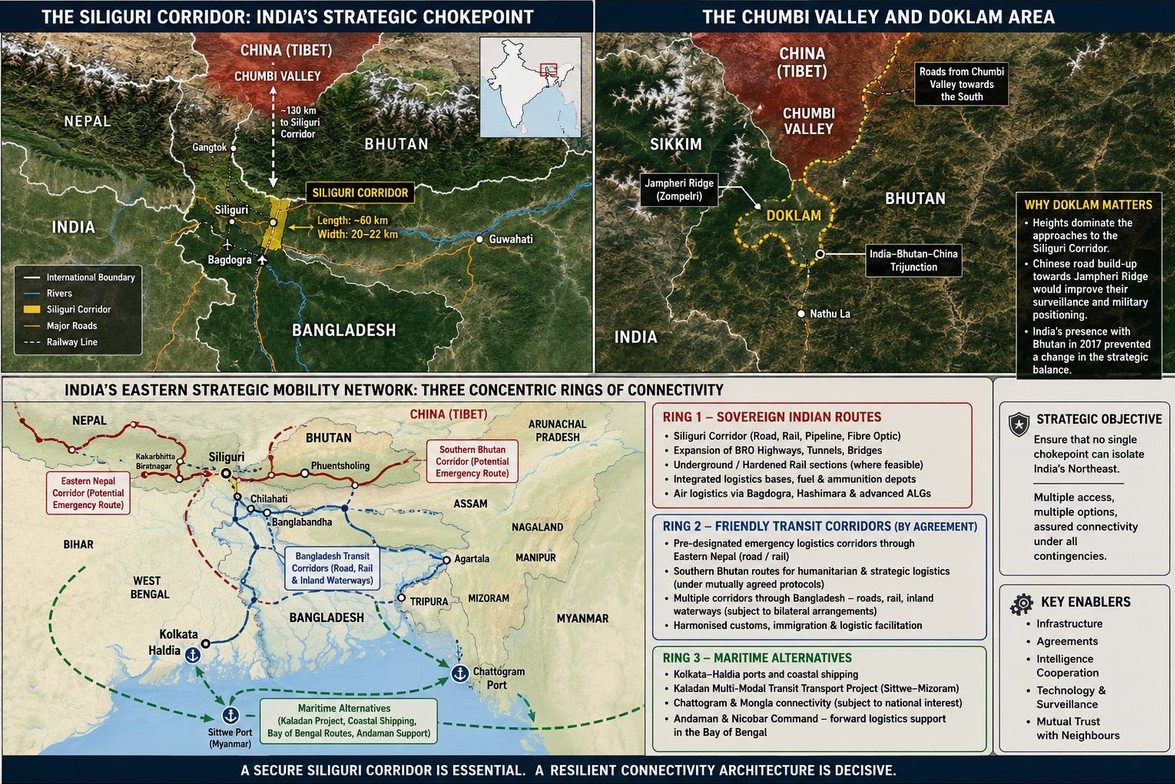
Such a framework would also serve the interests of Nepal and Bhutan by improving regional trade, tourism, disaster relief and economic integration while reducing their own dependence on single transport corridors. For India, the value would be profound. Strategic resilience is created not merely by deploying more troops along vulnerable frontiers, but by ensuring that no adversary can hold national connectivity hostage through the disruption of a single geographical chokepoint. By embedding Nepal and Bhutan within a cooperative architecture of connectivity and contingency planning, India would transform two friendly neighbours into indispensable partners in safeguarding the security of the eastern Himalayas.
This idea is innovative but grounded in strategic logic. It draws on European concepts of military mobility and resilience, adapted to South Asian realities, and is far more politically feasible than seeking permanent transit rights for Indian military forces through either country. It presents the arrangement as one of regional resilience, disaster response and emergency logistics, making it both diplomatically acceptable and strategically valuable.
Conclusion: From Chokepoint to Gateway
Geography cannot be rewritten. The Siliguri Corridor will always remain India’s most vulnerable strategic land bridge. Yet vulnerability need not become weakness. History demonstrates that nations overcome geographical disadvantages through superior strategy, resilient infrastructure and wise diplomacy. India has already begun this transformation by strengthening military deterrence, enhancing surveillance, expanding regional connectivity and deepening partnerships with Bangladesh, Bhutan and Nepal. The task ahead is to accelerate these efforts.
If military preparedness is matched by diplomatic foresight and infrastructure diversification, the Siliguri Corridor will cease to be viewed merely as India’s “Chicken’s Neck”. Instead, it will emerge as the secure gateway through which India’s Act East vision, economic integration and strategic influence across the Indo-Pacific are projected. The defence of Siliguri is therefore not simply about protecting territory. It is about preserving India’s unity, strengthening its resilience and ensuring that geography serves national strategy rather than constrains it.
The article was first published under the personal account at Substack of Lt. Gen Shokin Chauhan on 06 July 2026 and can be accessed here.