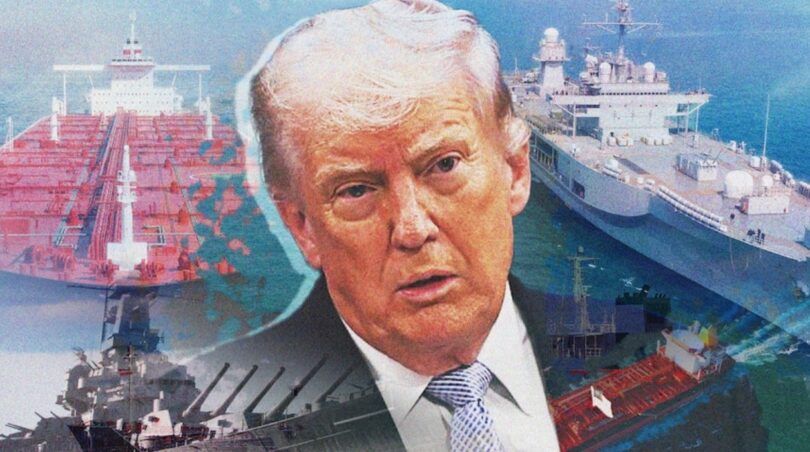

President Donald Trump’s recent claim on Truth Social posts declaring that the United States has “total control” over the Strait of Hormuz is best comprehended as a stylistic assertion of dominance rather than an empirically defensible description of maritime reality.
This blanket assertion mistakenly treats separate variables—military, operational, legal, and political—as a single absolute indivisible truth. To put it simply, the post presents itself as rhetoric which does not reflect power dynamics and functionalities but rather a linguistic effort to create it.
The strait of Hormuz is a consequential chokepoint, which acts as a critical commercial artery for a vast portion of global oil and liquefied natural gas trade. As a result of this economic importance, any disruption to its access will transcend from regional rivalry to a global market instability. Therefore, making any claims of unilateral ownership presents a direct challenge to its governing international framework.
Law and maritime order
The UN shipping agency has warned that nations must refrain from obstructing the freedom of navigation in Hormuz, especially with regards to tolls or unilateral restrictions as it would set a dangerous precedent. Reuters has also reported numerously on Iranian efforts to redefine the terms of passage, including proposals involving fees, permits, and oversight of inbound and outbound traffic. While those declarations serve coercive ambition, they do not amount to internationally accepted sovereignty over the strait. However, they do indicate how contested the legal status of Hormuz remains.
Hence Trump’s claim is analytically problematic. “Total control” suggests a settled condition, yet every recent report reflects the opposite: a fragile, negotiated, and reversible arrangement shaped by ceasefire terms, shipping anxieties, and diplomatic negotiating.
Iran may seek management authority, fee collection, or inspection rights, but the conflict itself highlights that no actor has secured uncontested jurisdiction. The strait remains a zone of contestation, not control.
Military balance
Militarily, the United States is a formidable external actor in the Gulf. It can escort vessels, conduct interdiction, suppress attacks, and impose costs on Iranian escalation. But there is a stark difference between dominance in a crisis and “total control” of a corridor that remains exposed to asymmetrical disruption. Variables such as mines, drones, missiles, fast attack craft, cyber pressure, and covert sabotage present Hormuz as a challenging operating environment in which even a superior navy cannot guarantee permanent, cost-free control. The question whether the U.S. has more power than Iran is not relevant in this scenario, rather if it can ensure uninterrupted freedom of navigation under hostile conditions. On basis of the recent developments, it can be inferred that it cannot sustain this on its own and certainly not permanently.
This acts as an evidentiary proof especially when the broader conflict context is taken into consideration. Reuters has reported that Iran’s Revolutionary Guards (IRGC) have taken a more central role in wartime decision-making, tightening the regime’s hard-line stance and sustaining its drone-and-missile strategy. Far from being decimated, the IRGC remains a key coercive instrument, and Iran has continued to use personnel, and equipment transfers to support pressure campaigns beyond its borders. Trump’s assertion that Iran has no meaningful military capacity is therefore too absolute to be credible. Iran may be damaged, but certainly not neutralized.
Economic reality
The economic declarations in the post are equally exaggerated and overstated. Iran’s economic situation is severe, and inflation remains extraordinarily high by ordinary standards, but the available reporting does not support a precise 300 percent figure. Additionally, macroeconomic distress does not automatically translate into strategic incapacity. Nations may be rendered weak fiscally, but can still utilize coercion, maintain elite unity, and leverage strategic chokepoints.
The difference between economic weakness and strategic collapse is critical, and Trump’s phrasing blurs that difference.
This is crucial because Tehran’s leverage does not depend on conventional parity. Strategically speaking, Iran does not have to defeat the U.S. Navy in open battle to make Hormuz politically and economically unstable. It only needs to sustain enough ambiguity and disruption to force insurers, shippers, Gulf producers, and energy markets into a risk-averse position. Hence the importance of the strait despite Iran’s military and economic stance appearing constrained.
Signalling and credibility
Trump’s post should therefore be read as a signalling device. It is designed to communicate momentum, inevitability, and dominance to domestic and foreign audiences alike. In some sense, it can be viewed through the lens of psy-ops to induce psychological pressure.
The message that Washington is trying to convey is that it has already settled the contest and that resistance by Iran is futile. But exaggerated signalling, certainly presents a failed narrative with the loss of credibility. The more absolute the claim, the easier it is for observers, markets, and adversaries to identify the gap between rhetoric and reality. Strategic messaging may be acceptable it is believable.
Furthermore, indicating a unilateral control over an international strait presents a contrary action with regards to the understanding in the international community. Recent Reuters reporting shows that even proposed arrangements for reopening Hormuz remain dependent on delicate sequencing, compensation demands, and contested definitions of control.
It is vital to note even though United States retains superior military leverage and can impose serious costs on Iran, Tehran retains enough asymmetric capability and institutional hardening to keep Hormuz a consistent risk.
Conclusion
The episode illustrates a recurring pattern in crisis politics, leaders often prefer clean narratives of control, while the underlying reality is contingent and contested. Trump’s post is analytically categorical to survive scrutiny with higher chances of a failed narrative. The Strait of Hormuz remains open to disruption, Iran remains weakened but dangerous, and the United States remains powerful without being omnipotent. That is the strategic picture hidden beneath the bombastic assertion of dominance.
More on topics about the Strait of Hormuz:
Greece Eyes Hormuz Security Mission: https://www.thestrategicperspective.org/greece-eyes-hormuz-security-mission/
China-Linked Tankers Cross Hormuz: https://www.thestrategicperspective.org/china-linked-tankers-cross-hormuz/
Attack on Thai Cargo Ship in Strait of Hormuz Signals Escalating Maritime Crisis: https://www.thestrategicperspective.org/attack-on-thai-cargo-ship-in-strait-of-hormuz-signals-escalating-maritime-crisis/
China’s Water Threats, India’s Malacca Leverage and Growing Indo-Pacific Contestation: https://www.thestrategicperspective.org/chinas-water-threats-indias-malacca-leverage-and-growing-indo-pacific-contestation/
Future Submarines: https://www.thestrategicperspective.org/future-submarines/
US-Iran Conflict Boosts India's Naval Role: https://www.thestrategicperspective.org/us-iran-conflict-boosts-indias-naval-role/