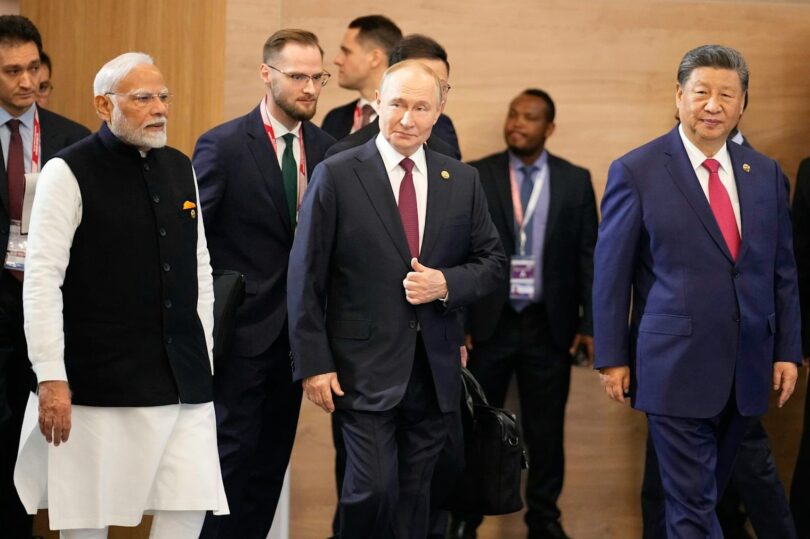

The Bishkek Summit, held between 31 August and 1 September 2026, marked the 25th anniversary of the Shanghai Cooperation Organisation (SCO) and was under Kyrgyzstan's chairmanship. The summit can be observed from two angles: firstly from that of as a routine annual gathering of a ten-member bloc built originally around border management and counter-terrorism, and secondly as a stage on which Xi Jinping, Vladimir Putin and Narendra Modi would signal, through seating arrangements and side-line handshakes as much as through declarations, where their three-way relationship currently stands.
An Agenda Broader Than Security
Kyrgyz officials structured the run-up to Bishkek summit around six core arenas: security, trade and economic ties, transport and logistics, energy, digital development, and cultural and humanitarian cooperation. This clearly highlights the evolution of the organization, from one primarily focused on counter-terrorism and border-management to a broader platform for economic and regional cooperation.
While the bloc's two permanent institutions remain the Regional Anti-Terrorist Structure (RATS) and the Secretariat, the Bishkek agenda placed importance heavily on connectivity, finance and digital cooperation sectors, where China's influence carries a disproportionate weight.
The plenary was chaired by Kyrgyz President Sadyr Japarov. The theme was "25 Years of the SCO: Together for Sustainable Peace, Development and Prosperity" which brought together the ten full members — China, Russia, Kazakhstan, Kyrgyzstan, Tajikistan, Uzbekistan, India, Pakistan, Iran and Belarus. Besides the full members, observer states such as Afghanistan and Mongolia, fifteen dialogue partners including Turkey, Egypt, Saudi Arabia and the UAE, and guests such as UN Secretary-General António Guterres and Turkish President Recep Tayyip Erdoğan were also present. Xi Jinping, Vladimir Putin, Narendra Modi, Pakistani Prime Minister Shehbaz Sharif and Iranian President Masoud Pezeshkian were confirmed for the Council of Heads of State session, alongside the leaders of Belarus, Kazakhstan, Uzbekistan and Tajikistan.
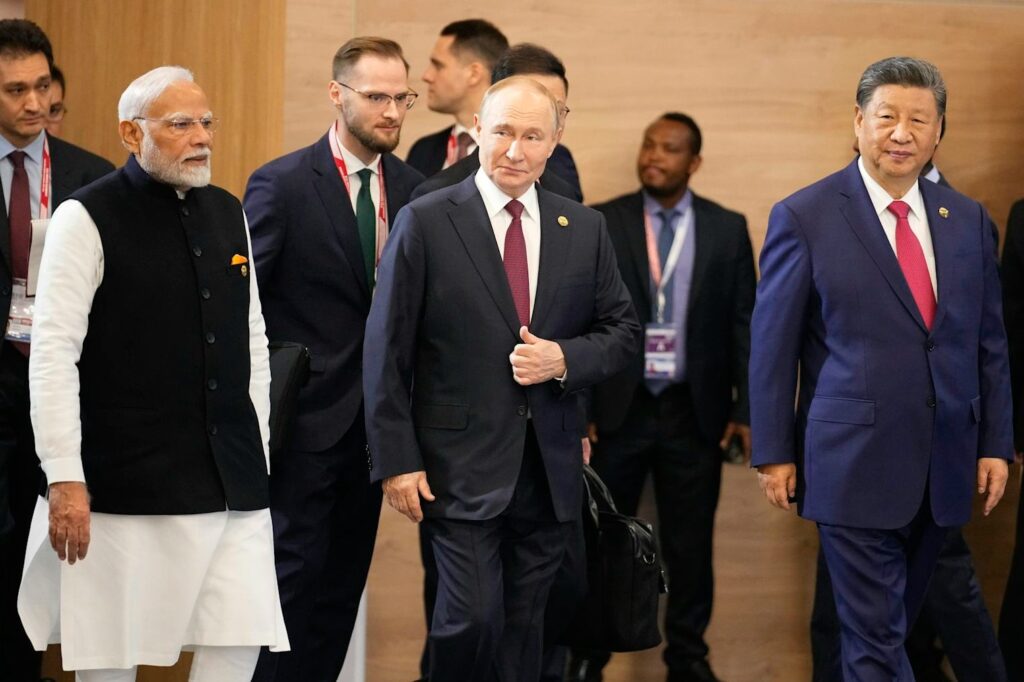
It is important to mention, the summit convened at the time when Washington's tariffs on Chinese and Indian goods and its sanctions on Iran provided the member states with a common and shared incentive to project unity even in areas where the bilateral tensions amongst some remain unresolved. Iran arrived at Bishkek in amongst the political uncertainty. Since the 28 February 2026 US-Israeli strikes on Tehran which led to the assassination of their Supreme Leader Ali Khamenei along with dozens of senior officials, the Islamic Republic was thrown into a crisis before an interim leadership council and later Khamenei's son, Mojtaba moved to stabilise the state. Against that backdrop, coupled with the unresolved Ukraine war and consistent disruption in the Black Sea, made West Asia a prominent topic on every leader's agenda in Bishkek.
The Outcomes: Declaration, Charter, and a Crowded To-Do List
The Bishkek summit produced an extensive package of outcomes. This consisted of the Bishkek Declaration and 27 additional agreements covering security, counter-narcotics cooperation, artificial intelligence, biodiversity, energy, climate collaboration, nuclear security, regional logistics, and other areas of cooperation. The Indian delegation separately highlighted thirteen outcomes of significance to India, including four memoranda of understanding and more than twenty individual decisions.
The most vital development was the approval of a Protocol amending the SCO Charter. The amendment was accompanied by regulations governing two new security-related bodies, signalling a gradual evolution of the SCO’s institutional framework. Another key development was the adoption of English as an official working language of the SCO, along with Russian and Chinese. India had long advocated for this change, with these changes, the operational and translation burdens within SCO processes may be reduced.
The Bishkek Declaration, reaffirmed member states’ commitment to the UN Charter and the organisation’s Development Strategy to 2035. In the security arena, the nations confirmed to establish a Universal Centre for Countering Security Threats, while also highlighting the 22 April 2026 Pahalgam terror attack in India, expressing condolences and calling for accountability. It has also confirmed the creation of an International Centre for Combating Organised Crime and bolster the regional cooperation against cybercrime and other emerging digital threats.
On the financial front, the summit demonstrated both ambition and limitations. While leaders advocated for reforms to the global financial architecture and displayed support for the accelerated integration of Iran’s designated bank into the SCO Interbank Consortium, the long-discussed SCO Development Bank has not been launched yet. Despite strong support shown from Kyrgyzstan as the outgoing chair and Kazakhstan’s offer to host the institution’s headquarters, the project remains under negotiation rather than an operational lender.
SCO members condemned the 2026 US-Israeli strikes on Iran, while acknowledging Iran’s sovereignty and territorial integrity, and supported Tehran’s rights under the Nuclear Non-Proliferation Treaty (NPT).
Institutionally, the SCO also compressed its external engagement framework by combining the categories of observer state and dialogue partner into a single partner status, consolidating the SCO Plus outreach model first introduced at the Astana summit in 2024. This was done with the intention of simplifying SCO’s increasing network of external relationships.
Another important matter at the Summit was the issue of Connectivity. There was strong emphasis placed on the China-Kyrgyzstan-Uzbekistan Railway, which the SCO indicated as its flagship infrastructure project. The approximately 500-kilometre rail corridor connecting Kashgar to Andijan through the Torugart Pass has been under construction since December 2024 and is estimated to cost nearly USD 4.7 billion.
Member states adopted a biodiversity initiative as a part of its environmental cooperation, a 2026–2031 environmental action plan, and a 2026–2030 Green Technology Corridor programme. However, a proposed SCO Water Problems Analysis Centre never made it to the final package of documents.
India has agreed to host the first SCO Civilisation Dialogue Forum later in 2026. The summit also highlighted its intent to expanding youth exchanges and people-to-people engagement across the organisation.
The summit concluded with the transfer of the SCO’s rotating chairmanship from Kyrgyzstan to Pakistan for the 2026–27 term.
According to reports, Pakistan is expected to host the next Council of Heads of State summit.
Russia: Side-line Diplomacy Around a War Economy
Kremlin adviser Yuri Ushakov has indicated that President Putin would hold separate engagements with the President Xi Jinping, with Iran's Pezeshkian, and with Prime Minister Narendra Modi with regards to the Black Sea situation and "the Ukraine issue in general", alongside the fallout from the US-Israel war with Iran, which has unsettled energy and financial markets the SCO's members depend on.
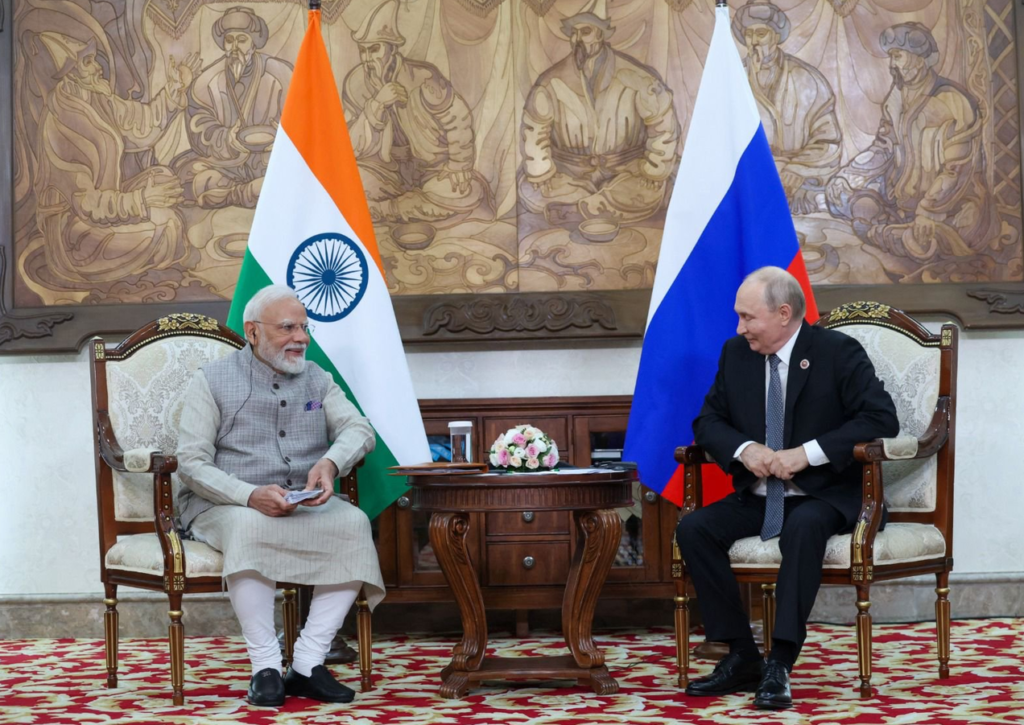
The Modi-Putin meeting, covered substantive list of topics, spanning from defence, energy, trade, space, mobility and cultural ties, building on the 27th session of the India-Russia Inter-Governmental Commission held in Moscow on 24 August 2026.
Modi flagged the safety of Indian seafarers affected by disruption in the Black Sea and West Asia and emphasized on the way forward with dialogue and diplomacy and not further escalation in regards with the Ukraine war. The Black Sea too, is an active theatre rather than a frozen front, with Russian and Ukrainian strikes on commercial and tanker traffic continuing through the summit itself. According to various reports, Russia struck two vessels and Ukraine hit a repair ship at a Russian oil terminal within days of Bishkek. Furthermore, the Ukrainian naval drones have degraded Russian basing at Novorossiysk and left the Bosphorus a de facto risk corridor for civilian crews, with vessels now rigging improvised drone defences to transit it. The Indian crews make up a significant share of world merchant shipping, the issue is a direct and recurring line item in New Delhi’s engagement with Moscow rather than a diplomatic courtesy. Putin was one of several leaders Modi met bilaterally on the summit’s margins, alongside Iran’s Pezeshkian, Armenian Prime Minister Nikol Pashinyan and Kyrgyz President Sadyr Japarov.
A substantial part of Bishkek’s real business happened outside the plenary hall. Modi and Putin travelled together to the opening of the World Nomad Games afterward, a small but deliberate signal of continuity, and Modi has also confirmed to host Putin in New Delhi for the 18th BRICS Summit on 12–13, September 2026.
India: Terrorism, Sovereignty Language, and Strategic Autonomy
Modi's address to the Council of Heads of State referenced the Pahalgam attack and reiterated that terrorism cannot be utilized as a strategic asset, and that nations providing safe havens or support to terrorist groups should be held accountable. "We must dismantle the entire ecosystem of terror financing, recruitment, radicalisation, and safe havens" he stated, adding that there could be no room for hypocrisy on the issue. He did not name Pakistan directly, but the remarks were delivered with Prime Minister Shehbaz Sharif present in the same hall.
Modi and Xi Jinping exchanged a brief, informal handshake and discourse ahead of the leaders' group photograph. No separate bilateral was formally scheduled between the two leaders. National Security Adviser Ajit Doval and Chinese Foreign Minister Wang Yi met in Beijing on August 25 to continue talks on the boundary question, and the two sides separately agreed to add two new meeting points for Senior Highest Military Commander-level talks and two additional border military hotline channels in the Eastern and Middle sectors. Earlier in August, both nations have conformed to work toward resuming direct flight connectivity and to ease visa facilitation for tourists, business travellers and media.
Who Actually Gained at Bishkek
Post-summit assessment suggests that Iran and China emerge as the summit's clearest beneficiaries. Iran secured not just sympathetic language but the bloc's unequivocal condemnation of the strikes which led to the assassination of its supreme leader and explicit backing for its NPT rights, a significant multilateral cover for Tehran while it remains under sustained US and Israeli pressure.
Turkish President Recep Tayyip Erdoğan said on September 2 that Turkey is currently an SCO dialogue partner and a NATO member and would consider full SCO membership while maintaining its existing Western relationships. Analysts have read that as evidence that states increasingly see closer SCO engagement as compatible with, rather than a substitute for, their existing Western ties, which would mark a meaningful shift in how the bloc is perceived beyond its founding Eurasian core.
More on related topics:
Trump, Hormuz, and Strategic Exaggeration: https://www.thestrategicperspective.org/trump-hormuz-and-strategic-exaggeration/
After Article 370: Security and Change in Kashmir: https://www.thestrategicperspective.org/after-article370-security-and-change-in-kashmir/
China’s Water Threats, India’s Malacca Leverage and Growing Indo-Pacific Contestation: https://www.thestrategicperspective.org/chinas-water-threats-indias-malacca-leverage-and-growing-indo-pacific-contestation/
Enforcing 'Ethnic Unity' in China: New 'National Identity' Law has Implications for Dalai Lama Succession and Tibetan Diaspora: https://www.thestrategicperspective.org/enforcing-ethnic-unity-in-china-new-national-identify-law-has-implications-for-dalai-lama-succession-and-tibetan-diaspora/