

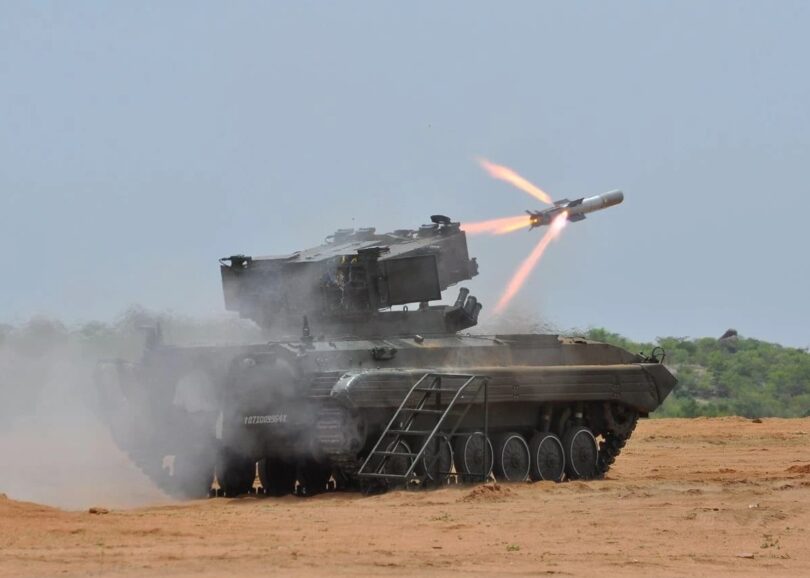

India conceived and officially started the Nag Anti-Tank Guided Missile (ATGM) project in 1983. The government gave its formal approval on July 26, 1983, under the Integrated Guided Missile Development Programme (IGMDP), led by Dr APJ Abdul Kalam (later President of India). The mission was that the Indian Army needed a modern, domestic ATGM without relying on imports from other countries. Instead of building one missile at a time, the government decided to build five different kinds of missiles all at once. The Nag was chosen to be India's premier 'tank buster'.
While the framework was set up in 1983, detailed development and design specifically for the Nag missile system kicked off in 1988. The first successful test firing of the Nag was conducted in November 1990. The project took many years to perfect because India wanted the Nag to be a 3rd-generation" missile. This means it uses "fire-and-forget" technology; once a soldier locks onto a target and presses the button, the missile guides itself using a heat-seeking camera. The soldier can immediately hide or move away safely.
Presently, India’s indigenous ATGM 'Nag' along with its man-portable version, the 'MPATGM', is a 3rd-generation weapon, featuring true fire-and-forget capability, and has an operational range of 500 metres to 4,000 metres for the core land versions. Its helicopter-launched variant 'Helina' (Dhruvastra) has a range up to 7,000 km. Just like the American Javelin or Israeli Spike, the Nag and MPATGM can climb steeply into the air after launch and strike a tank vertically from above, puncturing the thin upper armour. It features two consecutive explosive charges designed specifically to neutralize modern Explosive Reactive Armour (ERA) protection.
While the exact cumulative production numbers for the Nag and Helina missiles are classified, the MoD had originally cleared a baseline order of 300 Nag missiles and 25 NAMICA (Nag Missile Carrier) vehicles, while the Indian Army approved an order for 2,408 Nag Mark 2 missiles along with 107 NAMICA tracked carriers. For the Helina, MoD had granted the formal "Acceptance of Necessity" (AoN) to clear the missile for induction. BDL secured a contract worth INR 1,347.71 crore from Hindustan Aeronautics Limited (HAL) to supply Helina launchers and equipment, allowing outfitting of Rudra and LCH Prachand helicopters in a 2-to-5-year timeline.
In 2019, India began Importing Spike ATGMs from Israel. While the initial plan was to import 8,000 Spike missiles from Israel, only 240 Spike missiles along with 12 launchers were imported in order to prioritize domestic weapon programs and local manufacturing. The MoD signed a contract with Kalyani Rafael Advanced Systems (KRAS), a joint venture between India's Kalyani Group and Israel's Rafael Advanced Defence Systems to locally manufacture newer batches of Spike missiles in Hyderabad to fulfil the Indian Army's long-term demands.
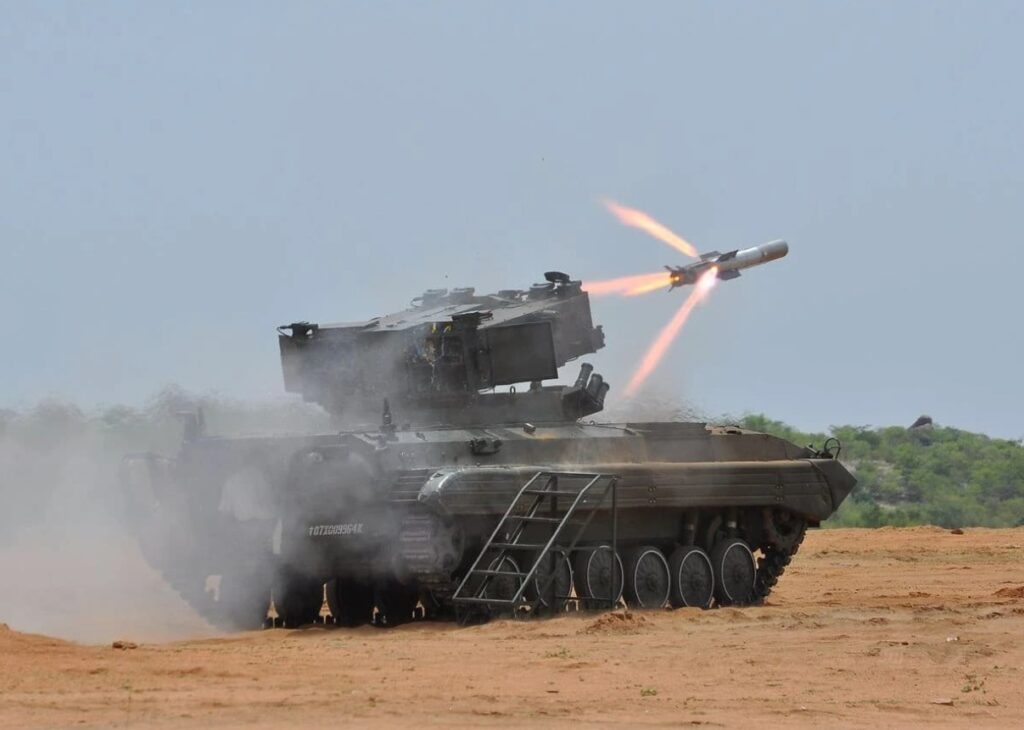
The exact number of Spike missiles produced by KRAS at its Hyderabad facility is classified due to strict confidentiality clauses by the MoD. However, when the INR 70 crore dedicated Spike facility was inaugurated in Hyderabad in 2023, the leadership stated the plant was built with ready infrastructure to manufacture 200 Spike missiles per month or 2,400 annually and 48,000 in a 3-year period. The missiles built at the Hyderabad facility feature 90% locally sourced components, meaning KRAS fully builds and integrates the physical missile units locally, excluding only the specialized explosives and propellants. In addition, KRAS openly shares milestones for other systems built at the same Hyderabad plant. For example, KRAS has successfully manufactured and rolled out its 100th Medium-Range Surface-to-Air Missile (MRSAM) kit for the Indian Armed Forces as part of a larger USD 100 million order to deliver 1,000 missile subsystems.
According to news reports of August 28, 2026, India has formally signed a Letter of Offer and Acceptance with the United States for the acquisition of the FGM-148 Javelin anti-tank guided missile system (ATGM). The deal, valued at approximately USD 45.7 million, was notified to the US Congress by the Defence Security Cooperation Agency in November 2025,
In a post on X Sergio Gor, US Ambassador to India expressed happiness over the deal. Under the agreement, India will procure 100 Javelin rounds, one missile for “fly-to-buy” evaluation, and 25 Javelin Lightweight Command Launch Units, also referred to as Block-1 Command Launch Units. The package includes training equipment, missile simulation rounds, a battery coolant unit, technical manuals, lifecycle support, spare parts, and systems integration and testing.
The Javelin FGM-148 ATGM, produced jointly by America's Raytheon and Lockheed Martin, has an effective firing range of 2,500 to 4,000 metres, depending on the variant and launch setup. Early variants were generally limited to 2,500 metres, while newer versions utilizing updated Command Launch Units (CLUs) reach up to 4,000 metres in the field. Weighing 15.8 kg, this fire-and-forget missile can be operated by a single soldier.
Deployed in the US and multiple international allies, its primary operators are: Europe – Britain, Ukraine, Poland, France, Norway, Estonia, Lithuania, Czech Republic, Croatia and Albania; Asia & Oceania - Australia, New Zealand, Taiwan, Indonesia, Georgia; Middle East & Africa: Jordan, Saudi Arabia, United Arab Emirates (UAE), Oman, Qatar, Bahrain, Ireland, and Libya.
Indian defence sources say the immediate procurement is primarily an "emergency acquisition". The long-term objective is to establish a domestic manufacturing capability for the Javelin in India, following an agreement signed in February 2026 between Bharat Dynamics Limited and the Javelin Joint Venture, owned by Raytheon and Lockheed Martin. Lockheed Martin stated that the arrangement would allow the joint venture to evaluate the feasibility of producing Javelins domestically to meet future requirements of India's Ministry of Defence (MoD) and strengthen India’s anti-tank capabilities.
According to another news report, Lockheed-Raytheon signed a MoU with Tata Advanced Systems for final assembly of FGM-148 Javelin ATGM using US-made subassemblies from Troy Alabama and Tucson Arizona plants. The co-production plan would provide India not only with access to the weapon system but also with the potential to build a domestic manufacturing ecosystem around one of the world’s most widely used man-portable anti-armour systems.
The hype in the media is that the Javelin is best suited for the Indo-Pacific because Russia doesn't have an ATGM matching the Javelin. But where is the Russian armour expected to advance or attack in the Indo-Pacific? The armour threat in the Indo-Pacific is from China, not Russia, and China does have an ATGM that directly matches America's FGM-148 Javelin; China's HJ-12, which is also known as the Hongjian-12 or Red Arrow 12.
In August 2010, then Defence Minister AK Antony informed Parliament that a Letter of Request would be issued to the US under the Foreign Military Sale route, with transfer of technology for this ATGM. At that time, the Indian Army faced a shortfall of 44,000 ATGMs against a sanctioned strength of 81,000. By 2012, however, the Javelin deal had stalled due to disagreements over transfer of critical technology and the US government’s reluctance to participate in field trials. India subsequently opted for Israel’s Spike ATGM, but the larger procurement plan collapsed after the Defence Research and Development Organisation (DRDO) insisted it could develop a similar indigenous system.
An analysis of the above would lead to multiple conclusions, including the following: one, the approach of MoD for addressing equipping gaps of the Armed Forces is grossly kneejerk; two, the slogan of Atamnirbhar (self-sufficiency) in Defence can be pushed under the carpet anytime; three, money-making, kickbacks and geopolitical appeasement gets precedence over everything else; four, the production rate of indigenous Nag and Helina has not been accelerated perhaps by design to facilitate foreign ventures and investments – not very different from allowing the indigenous NaVIC to become a failure; five, the Javelin deal appears to be a part of the agreement between Prime Minister Narendra Modi and President Donald Trump for a bilateral trade aimed at USD 500 billion; Six, the deal is also a sweetener for Washington after India finally cancelled the Stryker deal (vintage ICV) deal that the US was consistently trying to force through.
The world is witness to the havoc the FPV drones are wreaking on armour/armoured vehicles. With KRAS producing around 24,000 Spike missiles annually plus Nag and Helina missiles, is emergency procurement an excuse to push through the Javelin deal? Are we expecting armour attacks from China across the Himalayas, Pakistan, Bangladesh, or all combined?
Concurrently, India is going great guns in terms of defence exports, but needs to exercise discretion and caution. India's indigenous Swathi radar was compromised after export to Armenia. In early 2023, Armenia’s National Security Service busted an espionage ring within its own military. A Captain in the Armenian Armed Forces was caught and arrested for having leaked top-secret tactical and technical specifications of the Swathi radar system. While the Armenian government did not name the country, it is widely suspected by defence analysts that the leak went to Azerbaijan or its close defence allies, Turkey and Pakistan
India has exported over 20 lethal Hermes 900 military drones (manufactured in Hyderabad by Adani-Elbit Advanced Systems India) and hundreds of thousands of ammunition components to Israel, with transfers processed across some 2,596 shipments since late 2023. India firmly supports a negotiated two-state solution to resolve the Israel-Palestine conflict. At the same time, India also has strong defence ties with Israel, and Tel Aviv has been sharing critical technologies with India which others do not.
A recent news report of September 4, 2026 states that Estonia's Defence Minister Hanno Pevkur has resigned taking responsibility for termination of the €70 million (over INR 770 crore) deal to supply 155mm artillery shells to Ukraine over delays and alleged quality concerns. The deal, funded through the European Union’s European Peace Facility (EPF), was awarded to an Italian-registered company owned by an Indian defence firm; Nagpur-based Neco Defence Munitions, a subsidiary of Jayaswal NECO Group. The company naturally denies that the ammunition was faulty.
It is not possible that India's MoD was unaware that this ammunition was meant for use against Russian forces, while the Indo-Russian Strategic Partnership in October 2000 was upgraded to its current "Special and Privileged" status in December 2010. Because if the MoD was unaware, then Indian companies can easily supply arms and ammunition to state-sponsored terrorist organizations and terrorist states. Also, at any given time, the Indian Army itself is estimated to hold between 15,000 to 20,000 tonnes of segregated, faulty ammunition. This defect issue has been a longstanding, ongoing problem going back decades, with serious manufacturing defects specifically tracked and causing major issues since 2010.
The author is an Indian Army veteran. Views expressed are personal.
More on defense tech:
The AI-Human Mashup: https://www.thestrategicperspective.org/the-ai-human-mashup/
India's Reconsideration of the K30 Biho: https://www.thestrategicperspective.org/indias-reconsideration-of-the-k30-biho/
From Akash to Lusan: Armenia's Indian Arsenal Gets Armenian Names: https://www.thestrategicperspective.org/from-akash-to-lusan-armenias-indian-arsenal-gets-armenian-names/
The BrahMos Bubble: https://www.thestrategicperspective.org/the-brahmos-bubble/
SDA Launches First Operational Satellites on SpaceX Falcon 9: https://www.thestrategicperspective.org/sda-launches-first-operational-satellites-on-spacex-falcon9/
Patriot Missile Incident in Bahrain: Civilian Blast Raises Questions in the 2026 Iran War: https://www.thestrategicperspective.org/patriot-missile-incident-in-bahrain-civilian-blast-raises-questions-in-the-2026-iran-war/
India Successfully Test-Fires Agni-3: https://www.thestrategicperspective.org/india-successfully-test-fires-agni-3/