The credit for the Islamic Bomb in Pakistan goes to China, with the US turning a Nelson’s Eye. China supplied 500 ring magnets to kick start Pakistan’s nuclear program and later conducted the first Pakistani nuclear device test on Chinese soil in Lop Nor. Pakistan’s AQ Khan indulged in blatant nuclear proliferation but the CIA never questioned him, while Musharraf feigned Pak government had no hand in it. China supplied nuclear-capable Silkworm missiles to Saudi Arabia decades back and Pakistani nukes were reportedly ready to be shipped to Saudi Arabia if Iran went nuclear.
The book ‘Nuclear Express’ by Thomas C Reed and Danny B Stillman (former Secretary USAF) said that during the Deng Xiaoping regime, China believed that use of nukes against the West by radical/rogue countries would be good for China provided the trail is not traced back to China, hence nuclearization of Pakistan and North Korea. The book also states that Israel’s nuclear-weapons program was helped by France and South Africa; South Africa supplying uranium in return for weapons technology and Israel tested a neutron bomb in September 1979 - detonating it inside a steel bank vault on a barge 1,500 miles southeast of Cape Town, South Africa.
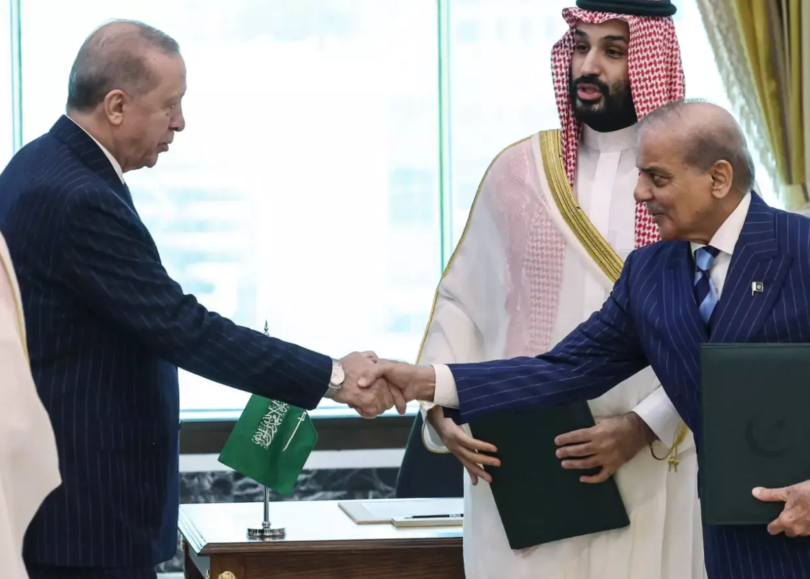
Following the Saudi-Pakistan SMDA, Turkey, Saudi Arabia and Pakistan signed a defence agreement in Mecca on August 7, 2026. The agreement states that an armed attack on one will be regarded as an attack on all, resembling NATO’s Article 5. An odd analyst in India has jumped to the conclusion that this alliance of 3-Muslim countries should not be termed “Islamic NATO” on the plea that the agreement does not specify the nature or scale of assistance. But such an assumption is politically motivated keeping the Muslim vote bank in mind.
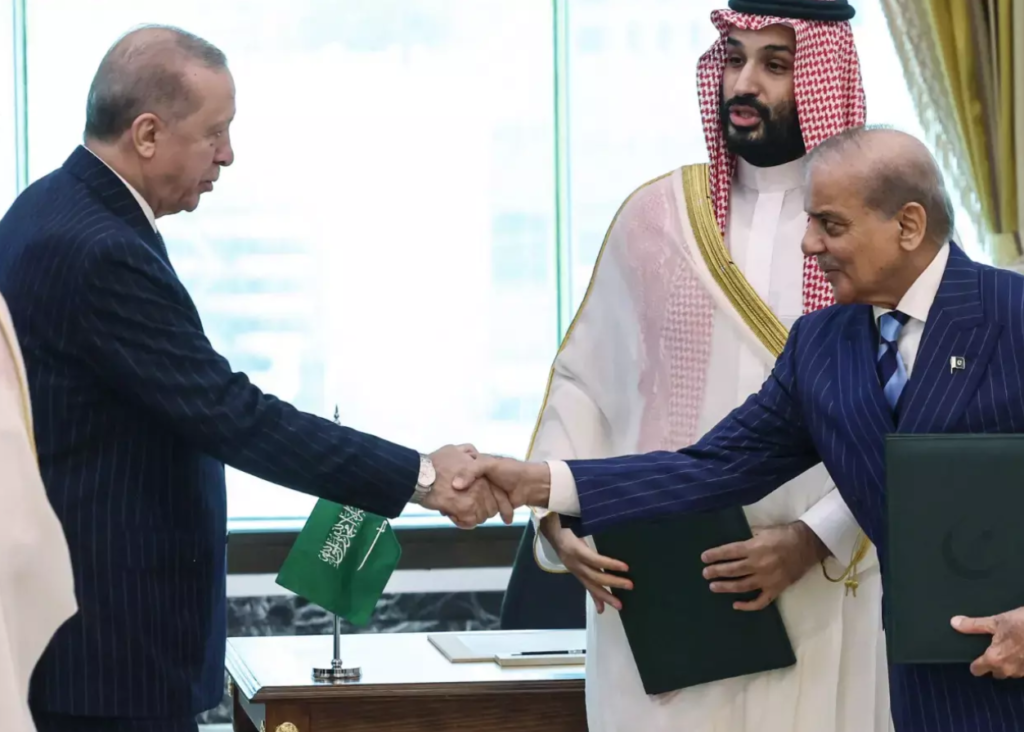
Take the case of the SMDA, which also does not explicitly specify the nature and scope of the military assistance to each other. The text is silent on whether Saudi Arabia comes under Pakistan’s nuclear umbrella. However, after signing the SMDA, Pakistan provided substantial military assistance to Saudi Arabia that materialized in April 2026 amid heightened Middle East tensions following outbreak of the US/Israel–Iran war:
- Troop Deployment. Pakistan supplied some 8,000 military personnel to protect critical infrastructure in Saudi Arabia and has pledged to scale this up to 80,000 troops if an extreme security emergency arises.
- Combat Air Power. Pakistan sent a squadron of 16 JF-17 Thunder fighter jets (jointly produced by China and Pakistan) to Saudi Arabia, which are stationed at the King Abdulaziz Air Base in Saudi Arabia's Eastern Province. The deployment includes two squadrons of Pakistani unmanned aerial vehicles (UAVs) to assist with aerial surveillance and reconnaissance.
- Integrated Air Defence Systems. To counter the threat of incoming drone and missile strikes targeting Saudi refineries, Pakistan has deployed a China-supplied HQ-9 long-range surface-to-air missile system in Saudi Arabia.
- Personnel Mechanics. In transactional arrangement, the hardware is completely operated by Pakistani personnel but entirely financed by Riyadh.
In exchange for this rapid deployment of military assets, Pakistan secured vital economic relief, including a USD 3 billion cash deposit rollover in April 2026 and an additional USD 5 billion financial facility from Saudi Arabia in July 2026.
The Turkey-Saudi Arabia-Pakistan defence agreement signed on August 7, 2026, is in effect a strategic integrated and trilateral expansion of the SMDA, looping in Turkey. It reflects ‘Islamic NATO Synergy’, under which Pakistan contributes its operational military manpower and implicit nuclear deterrence weight, while Turkey provides advanced drone technology and Saudi Arabia provides massive financial capital.
Pakistan’s Defence Minister Khawaja Asif has connected Operation Sindoor to the Mecca Joint Defence Agreement signed between Pakistan, Saudi Arabia and Turkey. While the three countries describe the pact as defensive, Asif’s comments have introduced India into the equation, particularly in relation to its expanding cooperation with Afghanistan.
Turkey has hinted that the grouping could expand beyond three countries, with Egypt mentioned as a possible addition. Such an expansion would mark the emergence of a new regional security equation – Islamic NATO, institutionalising collective defence among key Muslim-majority states, reducing reliance on external powers. The evolving situation underscores the shifting balance of power in West Asia. With Iran, Israel and the US locked in confrontation, the Mecca Agreement adds a new layer of collective defence among Sunni-majority states. For India, this development demands close scrutiny, as it could alter strategic calculations in any future conflict with Pakistan. According to Mehdi Rahimi, head of Iran’s news agency ‘Khaneh Mellat’, Tehran has also received an invitation to join the Mecca Defence Agreement.
The Mecca Defence Agreement certainly poses more than simple hybrid threats to India. Analysts view it an effort of Arab/Muslim countries to move away from the US but this may take many years especially in the case of Saudi Arabia. Pakistan anyway must play protégé to both the US and China. Donald Trump promoted the SPDA, hoping Saudi Arabia would lead Arab Nations to join the Abraham Accords. This may not happen but Trump will support the Mecca Defence Agreement, hoping it will destabilize South Asia and ignite an India-China war, for the US to advance its strategic and economic interests.
The action of US Ambassador to India Sergie Gor’s in this context are noteworthy. Visiting Srinagar, he announced that Kashmir is an “important” (not integral) part of India. This was an obvious attempt to mollycoddle India after the American ambassador to Pakistan had visited Pakistan occupied Kashmir during Donald Trump’s first presidency calling it “Azad Kashmir”. Gor’s Srinagar visit was simultaneous to Chinese and Turkish aircraft unloading military equipment and drones in Pakistan. Gor then visited Ladakh and wanted to meet the Dalai Lama in order to annoy Beijing, knowing that President Xi Jinping is likely to visit India next month for the BRICS Summit. Gor’s disclosure at this stage that India requested no questions by the press to Modi during the Modi-Trump meeting on the sidelines of the G7 Summit on June 17 is certainly not in good taste, knowing Modi dislikes questions by the media and hasn’t held a single press conference in India since he became prime minister in 2014.
According to an August 2026 report by the Pew Research Centre that surveyed over 42,000 people across 36 countries, found that: 67% respondents held unfavourable views of Israel; majority middle-income countries feel the US interferes heavily in other nations' affairs; only six countries including Indi favour the US over China, in addition to Israel, Japan, Poland, he Philippines and South Korea (https://www.pewresearch.org/global/2026/07/15/people-in-many-countries-now-view-china-more-positively-than-the-u-s/?gad_source=1&gad_campaignid=23983542891&gbraid=0AAAAA-ddO9FeWDH302DFtZtPDX_UmR6YH&gclid=EAIaIQobChMI4LSKhP-1lgMVc6VmAh0UqTMSEAAYAiAAEgIAP_D_BwE). An erudite scholar-analyst notes: “India has put all its eggs in the US-Israel basket in spite of Trump bashing India every time including imposing 100% tariffs and imposing fresh sanctions at the drop of his golf cap if we don’t tow the US line. The US has undermined India’s LCA Tejas Project and delayed supplies of the GE F-404 aero engines. But leave aside Canada, India doesn’t even have the guts to stand up to the US, as demonstrated by a small country like Spain. Sitting in America’s lap, it is amusing to see EAM Jaishankar attempting to woo China because Xi Jinping may visit India, and NSA Ajit Doval in Beijing for another umpteenth meeting for border talks with China’s Foreign Minister Wang Yi amid news of Chinese intrusion=ns In Arunachal Pradesh.”
At the same time, Chinese analysts are warning that India's Great Nicobar project is to monitor and influence the Malacca Strait, threatening China's maritime lifeline; calling for: for a stronger blue water navy and rapid combat readiness of the aircraft carrier Fujian to counter India and the US; faster Malacca bypasses via Kyaukphyu, China-Myanmar pipelines and the Kra Land Bridge; resolving Taiwan. China also officially opposed the Quad’s joint project to develop massive port infrastructure in Fiji - specifically in Suva and Lautoka. This was strongly reiterated by the Chinese Foreign Ministry following the Quad Foreign Ministers' Summit in New Delhi in May 2026 chaired by Jaishankar; arguing that regional cooperation should promote general peace and stability rather than targeting a specific third party.
Strategic competition between China and the Quad (of which India is a part) drives the geopolitical friction in the Pacific Island nations in several areas, like: China views satellite data to track illegal fishing a cover for military surveillance and intelligence gathering on its naval movements; Quad funding of undersea internet cables to prevent Pacific nations from using Chinese state-backed firms; Quad’s infrastructure development militates against China’s Belt and Road Initiative (BRI). China views India firmly in the US camp.
India’s foreign policy is a failure with respect to its immediate neighbourhood, even though India is supplying refined petroleum products to Nepal, Bhutan and now Mauritius; conventional and standard commercial fuel grades – not the ethanol-blended petrol (E20) forced within India. Among the Gulf States, India-UAE relationship is the strongest. According to the Forbes World's Billionaires List, Indian expatriates represent the most heavily featured foreign nationality among the ultra-rich residing in the UAE, with their combined wealth assessed at about USD 49.9 billion. Industry data indicates that 25,000 to 30,000 Indian millionaires permanently reside in the country, primarily anchored in Dubai. India claims the leadership of Global South but 28 of the 30 Global South nations categorically reject Israel's statehood even as Modi called Isreal “Fatherland” and India “Motherland” while addressing Israel’s Knesset.
China’s existing J-20 fleet of 500 is set to double by 2030 and Beijing has signed a deal with Pakistan to supply 40 J-35A 5th-generation stealth fighters, with the first batch arriving in coming months – much before India’s AMCA. Moreover, none of the 114 additional Rafale India plans to procure will be 5th-generation - Rafale platform is not built with a 5th-generation low-observable (stealth) airframe. Deliveries are projected to begin in late 2029 or 2030, stretching through mid-to-late 2030s. India is too scared of Trump to take the Russian offer of the Su-57E offer under the Make in India initiative.
The China-Turkey-Pakistan trilateral already poses a significant threat to India. Dhaka's is upping defence arrangements with China, Pakistan and the US. Its defence agreements with Turkey for long-range air systems and co-produced drones creates a complex, multipolar web on India's eastern flank. As to the news that Dhaka is considering joining the Mecca Defence Agreement, it should be taken for granted that Bangladesh will do so egged on by both China and the US. India cannot afford to take all this lightly; it must seriously review its proposed military transformation with only three border specific Theatre Commands – that too worked out without a National Security Strategy.
The author is an Indian Army veteran. Views expressed are personal.